30 Indian Vegetarian Curry Recipes: The Ultimate Regional Guide to Gravies Across India
30 Indian Vegetarian Curry Recipes: The Ultimate Regional Guide to Gravies Across India
Indian vegetarian curry is not one dish but hundreds — from a thin, tangy Tamil rasam poured over rice like soup, to a thick Punjabi rajma scooped up with torn roti, to a pale Gujarati kadhi floating with pakoras. This guide covers 30 recipes across North, South, East, and West India, with full methods for anchor dishes and detailed notes on the rest, so you can cook real regional Indian curry from scratch.
Why You’ll Love These Indian Vegetarian Curry Recipes
- Genuinely regional, not generic: These aren’t “Indian curry” templates. Each recipe reflects the actual cooking traditions of its state — different oils, different spice orders, different textures.
- Beginner to advanced friendly: Simple dal tadkas sit alongside more involved Chettinad gravies. You can start anywhere.
- Pantry-forward and practical: Most of these use spices you either already have or can find easily — substitution notes are included for cooking outside India.
- Vegetarian (and often vegan): Every single recipe here is meat-free. Many are naturally vegan, and the dairy-based ones are flagged clearly.
- Deeply satisfying: There’s a reason these recipes have survived generations. They work. They’re delicious. And once you make them, you’ll come back to them again and again.
Prep Time: 20–30 minutes (varies by recipe)
Cook Time: 30–60 minutes (varies by recipe)
Total Time: 50–90 minutes average
Servings: 4 per recipe
Summary: This is a comprehensive regional guide to 30 of the best Indian vegetarian curry recipes from North, South, East, and West India. Each recipe covers authentic flavors, key spices, and practical tips — so you can cook real Indian gravy from scratch, wherever you are in the world.
The Foundations: Ingredients You’ll Need for Indian Vegetarian Curry Recipes
Before getting into individual recipes, here are the foundation ingredients that almost every Indian vegetarian curry shares. Understanding these will help you cook more intuitively.
The Essential Spice Pantry
- Cumin seeds (jeera): The backbone of most North Indian tadkas. Non-negotiable.
- Mustard seeds (rai/sarson): Dominant in South and West Indian cooking. They crackle and pop in hot oil — that sound means you’re doing it right.
- Turmeric (haldi): Goes into almost everything. Anti-inflammatory and beautiful. Turmeric has impressive science-backed health benefits.
- Coriander powder (dhania powder): Earthy and mild. Makes the base of most curry pastes.
- Red chili powder: Use Kashmiri for colour with low heat, regular for heat with less colour. Keeping both is worthwhile.
- Garam masala: Added at the end, not the beginning. It’s a finishing spice, not a base. (I know people who dump it in at the start and I won’t argue with them, but… I judge them a little.)
- Asafoetida (hing): Just a pinch. It smells alarming straight from the jar but becomes magical in hot oil. If you’re abroad and can’t find it, skip it — there’s no real substitute, unfortunately.
- Curry leaves: Fresh are irreplaceable, dried are better than nothing, frozen are surprisingly good. If you’re in the US, UK or Australia, look for them at your local South Asian grocery store.
The Wet Base Ingredients
- Onions: Most curries start with a base of slow-cooked, golden-brown onions. Don’t rush this step. Ever.
- Tomatoes: Fresh is best. Canned work in a pinch for North Indian gravies. South Indian curries often skip tomatoes altogether.
- Ginger-garlic paste: Make a big batch and freeze in ice cube trays. Equal parts ginger and garlic, blended with a little water. Life-changing tip.
- Yogurt (dahi): Used in Mughlai-style gravies, kadhi, and marinades. Always use full-fat. Always add it off the heat or on low heat to prevent curdling.
- Coconut (fresh, desiccated, or milk): Essential for South and West Indian curries. Desiccated coconut works when fresh isn’t available — just soak it in warm water first.
The Regional Breakdown: 30 Indian Vegetarian Curry Recipes by State
These recipes are organized as a true regional guide — North, South, East, West, and Central India. Within each region, the full method is given for 2-3 anchor recipes and detailed notes on the rest. This way you’re getting both a cookbook and a crash course in Indian food geography.
North Indian Vegetarian Curry Recipes (Recipes 1–9)
North Indian curries are what most of the world pictures when they hear “Indian food.” Rich, tomato-onion bases, generous use of cream or yogurt, warm whole spices, and that gorgeous orange-red colour. Punjabi cooking dominates here, but Uttar Pradesh, Rajasthan, and Himachal Pradesh all have distinct voices too.
Recipe 1: Classic Dal Tadka (Punjab)
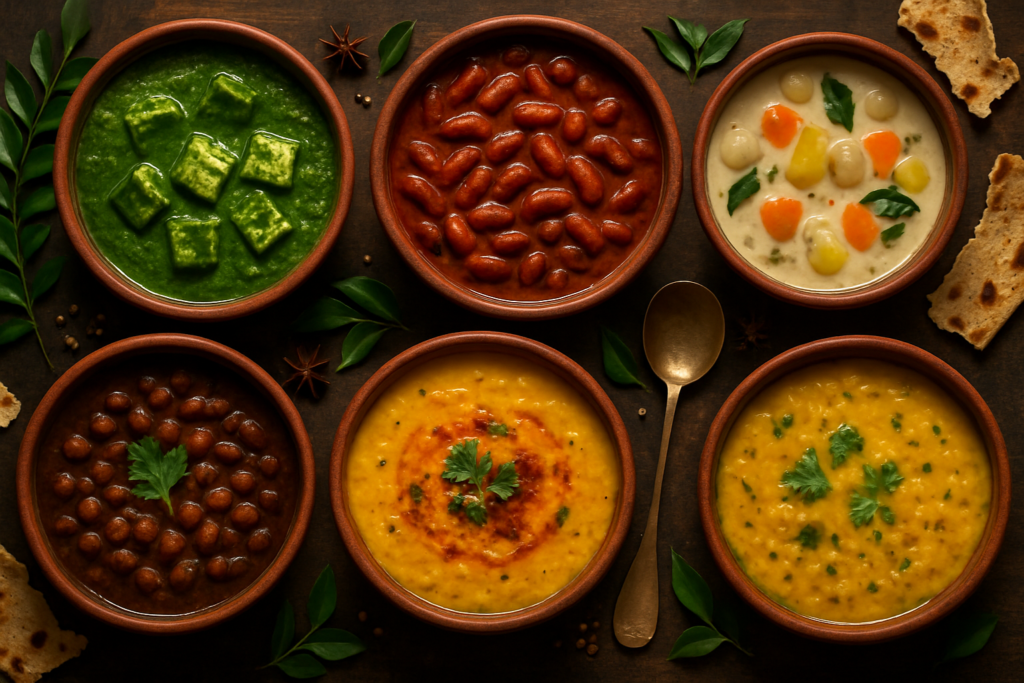
If there is one recipe to represent all of Indian home cooking, it would be dal tadka. Humble. Nourishing. Deeply comforting. The yellow dal (split pigeon peas or arhar/toor dal) is pressure-cooked until soft, then finished with a sizzling tadka — a tempering of ghee, cumin, garlic, red chili, and asafoetida that you pour dramatically over the top right before serving. It crackles and hisses and smells extraordinary.
Key flavors: Earthy, garlicky, smoky (especially if you use the dhungar charcoal smoke trick).
See the full restaurant-style dal tadka recipe here for step-by-step photos and the dhungar method.
Recipe 2: Palak Paneer (Punjab/North India)
Blanched spinach pureed with spices and fresh cottage cheese cubes — this is probably the most recognized Indian vegetarian curry recipe in the world. And yet, most restaurant versions do it a disservice. The real trick is NOT to cook the spinach to death. Blanch it briefly in salted boiling water, shock it in ice water immediately, then blend. That’s what keeps it bright green rather than army-khaki colored. A spoonful of cream and a tiny pinch of sugar right at the end rounds out the flavors beautifully — I know purists will disagree.
Key flavors: Verdant, fresh, milky, lightly spiced.
Recipe 3: Rajma Masala (Punjab/Himachal Pradesh)
Dark red kidney beans slow-cooked in a deeply spiced tomato-onion gravy. Rajma chawal — rajma with steamed white rice — is the ultimate North Indian comfort food.
The secret to excellent rajma masala: cook it long and slow. The beans need to give up some of their starch into the gravy for it to get thick and glossy. Don’t shortcut this. Also, soak your rajma overnight. Always. And add a pinch of baking soda to the soaking water if they’re old beans. Old beans are the enemy of a good rajma.
Key flavors: Deep, tomatoey, warming, rich.
Recipe 4: Paneer Butter Masala (Mughlai/North India)
Paneer butter masala and butter chicken are the same gravy. The base is identical: a cashew-tomato sauce with loads of butter and cream, sweetened slightly, and deeply aromatic. When you use paneer instead of chicken, you get this — one of the world’s most beloved Indian veg curry recipes. The key is making the tomato-cashew-onion paste ahead and really letting it fry in butter until the oil separates. Don’t skip that step.
Recipe 5: Chole Masala / Chana Masala (Punjab)
Chickpeas in a bold, sour-spicy gravy. What makes Punjabi chole different from other chickpea curries is the use of anardana (dried pomegranate seeds) or amchur (dry mango powder) for that characteristic sourness, and often a tea bag while boiling the chickpeas to darken them slightly. Chole bhature is the dish that makes people drive across cities in Delhi on Sunday mornings. It’s that good.
Recipe 6: Matar Paneer (Uttar Pradesh/Punjab)
Green peas and paneer in a tomato-onion gravy. Simple, weeknight-friendly, incredibly satisfying. Use fresh peas in winter — frozen work fine the rest of the year. Don’t overcook the peas; they should still have a slight bite.
Recipe 7: Aloo Matar Curry (UP/Bihar)
Potatoes and peas in a thin, home-style gravy. This is the everyday dal’s companion — lighter than matar paneer, equally delicious.
Recipe 8: Rajasthani Gatte ki Sabzi
Gram flour dumplings cooked in a tangy yogurt-based gravy. This dish is the genius of desert cooking — made entirely without fresh vegetables, using only dried pantry ingredients. It’s sour, spiced, and unlike anything else in Indian cooking. The yogurt gravy is tempered with cumin, coriander, and red chili, and has a gorgeous rust-orange colour.
Recipe 9: Kashmiri Dum Aloo
Baby potatoes deep-fried and then braised in a yogurt-fennel gravy. Kashmiri cooking has almost no onion or garlic — it relies instead on fennel seeds (saunf), dry ginger (soonth), and the famous Kashmiri red chili which is mild but breathtakingly red. This curry is deeply aromatic, slightly sweet, and absolutely stunning. Dum aloo has an interesting culinary history that spans both Kashmir and Bengal.
South Indian Vegetarian Curry Recipes (Recipes 10–18)
South Indian curries are a completely different universe from North Indian ones. Coconut is king. Mustard seeds and curry leaves are the starter pistol for almost every recipe. Tamarind provides the sour note that tomatoes do in the North. And the heat — oh, the heat is real. Tamil, Kerala, Andhra, Karnataka, and Telangana all have wildly distinct cooking styles.
Recipe 10: Kerala Vegetable Ishtu (Kerala)
A mild, coconut milk-based stew with potatoes, carrots, beans, and green peas. Ishtu is traditionally served with appam (lacey rice pancakes) and is one of the most gentle and beautiful curries in Indian cooking. No chili powder. No turmeric (or just a whisper). Just coconut milk, whole spices, green chilies, and fresh coconut oil poured over at the end. Don’t substitute the coconut oil. It makes the whole dish.
Recipe 11: Sambar (Tamil Nadu/Karnataka)
The great South Indian lentil and vegetable curry that goes with everything — idli, dosa, rice, vada. Every household has a different sambar recipe. The key ingredient is sambar powder — a complex spice blend that you can buy ready-made or make at home. Freshly made sambar powder changes this dish completely.
Recipe 12: Chettinad Kara Curry (Tamil Nadu)
From the Chettinad region of Tamil Nadu, this is one of the boldest, most complex curry recipes in all of India. It uses a freshly ground spice paste with kalpasi (stone flower), marathi mokku (dried flower pods), and other regional spices you may need to hunt for in specialty stores. Worth every bit of effort. Traditionally made with meat, the vegetarian version uses baby potatoes or raw jackfruit to brilliant effect.
Recipe 13: Kerala Kadala Curry (Kerala)
Black chickpeas in a roasted coconut gravy. Served with puttu (steamed rice cylinders) for breakfast in Kerala. The coconut is dry-roasted until deep brown before grinding — this is what gives the curry its characteristic nutty, dark gravy.
Recipe 14: Andhra Gutti Vankaya (Andhra Pradesh)
Stuffed small eggplants cooked in a sesame-peanut-tamarind gravy. Andhra food is famously spicy — this dish is no exception. The stuffing is a paste of roasted sesame seeds, peanuts, coconut, and tamarind that gets pushed inside each little eggplant, and then the whole lot is slow-cooked in a masala. Rich, complex, and slightly addictive.
Recipe 15: Karnataka Bassaru (Karnataka)
A two-stage dish — lentils are pressure-cooked with greens, the cooking water is used to make a thin, rasam-like soup (the bassaru), and the solid cooked dal and greens are tempered separately to make a thick side dish. Two dishes from one pot. Karnataka ingenuity at its finest.
Recipe 16: Mor Kuzhambu (Tamil Nadu/Kerala)
A thin, buttermilk-based curry with vegetables (usually ash gourd, yam, or okra) and a coconut-cumin paste. Think of it as the South Indian answer to North Indian kadhi — light, digestive, perfect over rice on a hot afternoon.
Recipe 17: Tomato Rasam (Tamil Nadu)
Technically a soup, but served as a thin curry over rice in South Indian meals. Tangy tomato, tamarind, and black pepper with a fiery mustard-cumin tadka. This is medicinal food — what you make when someone has a cold or an upset stomach. Also what you make when you want something that’s ready in 15 minutes and tastes incredible.
Recipe 18: Avial (Kerala/Tamil Nadu)
A mixed vegetable curry cooked in a coconut-yogurt sauce with curry leaves and coconut oil. Uses a glorious jumble of vegetables — raw banana, drumstick, yam, raw mango, carrots, beans — all cut into long pieces and cooked together. Avial is the curry equivalent of “use everything in the fridge,” but elevated to an art form.
West Indian Vegetarian Curry Recipes (Recipes 19–24)
Maharashtra, Gujarat, and Goa make up the western belt, and each region is utterly distinct. Goa uses coconut and vinegar. Gujarat is famous for its sweet-salty-sour balance. Maharashtra has both the spicy, pungent Kolhapuri style and the coconut-forward Konkan coast recipes.
Recipe 19: Gujarati Dal (Gujarat)
Sweet and slightly sour toor dal tempered with mustard, curry leaves, and a touch of jaggery. Thinner in consistency than North Indian dal tadka, perfectly balanced, and poured generously over rice. The jaggery is non-negotiable. Omitting it to reduce sugar produces a completely different dal — still good, but not Gujarati.
Recipe 20: Maharashtrian Amti (Maharashtra)
A toor dal curry with a characteristic Maharashtrian spice blend called goda masala — which contains dried coconut and kalpasi (stone flower) alongside the usual suspects. Amti has a beautiful sweet-sour-spicy balance, and the goda masala gives it a depth that regular garam masala simply can’t replicate.
Recipe 21: Kolhapuri Misal Pav (Maharashtra)
Moth beans (matki) cooked in a fiery red Kolhapuri gravy, topped with crunchy farsan, onions, tomatoes, and served with soft bread rolls. Misal pav is Maharashtra’s most loved street food, and the Kolhapuri version is the hottest of them all.
Recipe 22: Goan Vegetable Xacuti (Goa)
A rich, complex curry with roasted spices, dried chilies, and coconut. Xacuti uses a paste of roasted coconut, poppy seeds, and a long list of whole spices including star anise, cloves, and nutmeg. Traditionally made with meat, the vegetarian version with raw jackfruit or potato-cauliflower is spectacular. It’s intense and requires effort, but it’s unlike any other curry on this list.
Recipe 23: Bharli Vangi (Maharashtra)
Stuffed eggplants in a peanut-coconut-sesame masala. Maharashtra’s answer to Andhra’s gutti vankaya — different spices, different technique, equally wonderful. The small, round purple eggplants work best here. Score them crosswise at the bottom, stuff them with the masala, and cook them slow in a covered pan until they collapse softly into the sauce.
Recipe 24: Gujarati Undhiyu (Gujarat)
A slow-cooked mixed vegetable and bean curry from Surat, traditionally cooked upside-down in a clay pot underground. It’s the Gujarati dish — made especially in winter when the vegetables (surti papdi, raw banana, yam, baby potatoes) are all in season. Modern recipes use a pressure cooker or oven, and the result is still magical: deeply savory, herb-packed, and absolutely festive.
East Indian Vegetarian Curry Recipes (Recipes 25–30)
Bengali, Odia, and Northeastern cooking round out the eastern quarter. Bengali food has a sophistication that’s quietly breathtaking — mustard oil, panch phoron (the Bengali five-spice), and a subtle sweet note. Odisha’s cooking is temple-food influenced, often without onion and garlic. The Northeast (Assam, Manipur, Nagaland) uses fermented ingredients and bamboo shoots in ways that feel entirely their own.
Recipe 25: Bengali Cholar Dal (West Bengal)
Split Bengal gram (chana dal) tempered with coconut pieces, raisins, and ghee — a festive dal served at pujas and celebrations. The coconut pieces are fried until golden in the tempering, and the raisins plump up and add a gentle sweetness.
Recipe 26: Bengali Alur Dom (West Bengal)
Baby potatoes cooked in a spiced, slightly sweet gravy with panch phoron and a hint of whole spices. The Bengali version is drier and more caramelized than the Kashmiri dum aloo — cooked on a high flame until the potatoes are coated in a thick, spiced crust. Eat with luchi (Bengali fried flatbread) and you’ll understand why Bengalis are so obsessed with this pairing.
Recipe 27: Doi Potol (West Bengal)
Pointed gourd (parwal/potol) cooked in a yogurt gravy. This is quintessential Bengali home cooking — subtle, fragrant, and using a vegetable that is often overlooked outside Bengal. If you can’t find pointed gourd, this preparation works beautifully with zucchini.
Recipe 28: Odia Dalma (Odisha)
A thick dal cooked with mixed vegetables — raw banana, yam, raw papaya, and eggplant — tempered with panch phoron and coconut. No onion, no garlic. It’s temple food at its finest, and the combination of lentils and vegetables cooked together means it’s an all-in-one nutritious meal. The panch phoron tempering in ghee at the end is what ties it all together.
Recipe 29: Manipuri Eromba (Manipur)
A dish of boiled and mashed vegetables (often potatoes, with smoked dried mushrooms in the vegetarian version), mixed with fermented soya beans and green chili. Eromba is not what most people picture when they think of Indian vegetarian curry recipes, but it’s a deeply important dish from the northeast and deserves to be known more widely. It’s umami-forward, smoky, pungent, and unlike anything in the rest of Indian cuisine.
Recipe 30: Assamese Aloo Pitika (Assam)
Mashed potato seasoned with raw mustard oil, green chili, and onion. Aloo pitika is technically a side dish, but it can function as a light curry-style accompaniment over rice. The raw mustard oil is essential — it gives it that pungent, nose-clearing bite that is quintessentially Assamese.
How to Make Indian Curry from Scratch: The Master Method
Most of these Indian vegetarian curry recipes follow a master structure, with regional variations in which oil, spices, and souring agents are used. Once you understand this structure, you can cook almost any Indian curry confidently.
- Heat oil or ghee in a heavy-bottomed pan (kadhai or Dutch oven). The oil matters: use mustard oil for Bengali/Assamese dishes, coconut oil for Kerala, regular vegetable oil or ghee for North Indian curries.
- Temper whole spices (tadka/chaunk). Add cumin seeds, mustard seeds, bay leaves, cardamom — whatever the recipe specifies — to hot oil. They should sizzle and pop within 30 seconds. This step builds the aromatic foundation of the curry.
- Cook aromatics. Add onions (if using) and cook on medium heat, stirring regularly, until deeply golden — this usually takes 15-20 minutes and cannot be rushed. Add ginger-garlic paste and cook until the raw smell disappears, about 3-4 minutes.
- Add ground spices and cook. Coriander powder, cumin powder, turmeric, red chili powder — these go in now. Stir constantly for 1-2 minutes. If they start sticking, add a splash of water.
- Add tomatoes (if using) and cook until oil separates. This is the “bhunao” step — frying the masala until the oil comes out at the edges. This is how you know the masala is fully cooked. Don’t skip it.
- Add the main ingredient. Vegetables, lentils, paneer, beans — in it goes. Coat with the masala thoroughly.
- Add water or coconut milk to reach desired consistency. Bring to a boil, then simmer until the main ingredient is cooked through.
- Finish with garam masala, fresh herb, or a squeeze of lemon. Taste and adjust salt. The finishing touch elevates everything.
Tips for Perfect Indian Vegetarian Curry Recipes Every Time
- Cook your onions properly. Under-cooked onions are the #1 reason home curries taste raw and sharp. Low and slow is the way — golden at around 10 minutes, properly ready at 18-20 minutes.
- Bhunao the masala until oil separates. This is the most important technique in Indian cooking. When your tomato-spice paste has been fried until the oil beads out around the edges, the masala is cooked. This step creates depth that no amount of extra spice can compensate for.
- Season at each stage, not just at the end. A pinch of salt when you add the onions, another when the tomatoes go in, a final adjustment at the end. Layered seasoning builds complex flavor.
- Freshly ground spices make a significant difference. You don’t have to do it every time, but once a month, toast whole cumin and coriander in a dry pan and grind them yourself. The difference will genuinely surprise you.
- Resting time matters. Like most braised dishes, Indian curries taste better the next day. The spices settle, the flavors meld. If you can make your rajma or chole a day ahead, do it.
Variations for Different Dietary Needs
Jain-Friendly Variations
For Jain recipes, skip onion, garlic, potatoes, carrots, and all root vegetables. Replace with raw banana, raw jackfruit, lauki (bottle gourd), or paneer. The Rajasthani gatte ki sabzi and Gujarati dal are naturally Jain-adaptable.
No-Onion No-Garlic (Sattvic) Variations
Use asafoetida (hing) to replace the onion-garlic flavor in tadkas. Increase the quantity of fresh ginger, green chilies, and curry leaves for aromatics. Kashmiri dum aloo and Odia dalma are already naturally no-onion-no-garlic.
Vegan Variations
Most Indian vegetarian curries are already vegan — lentils, vegetables, and coconut milk are the natural base. For recipes that use ghee, substitute a high-quality unrefined coconut oil or cold-pressed mustard oil. For yogurt-based curries like kadhi, use cashew yogurt — it behaves very similarly to dairy yogurt when cooking.
Gluten-Free Variations
Almost all of these recipes are naturally gluten-free. The one to watch out for: some commercial asafoetida (hing) is mixed with wheat flour as an anti-caking agent. Buy the pure compounded hing from specialty stores, or look for “gluten-free hing” on the label.
What to Serve With These Indian Vegetarian Curry Recipes
- Rice: Plain steamed basmati for North Indian curries; short-grain sona masuri rice for South Indian gravies. Jeera rice (cumin-tempered rice) works beautifully with almost everything on this list.
- Breads: Roti or phulka for everyday meals; paratha for richer curries like rajma and chole; naan for occasion cooking like paneer butter masala. South Indian curries pair with appam, dosa, or idli.
- Accompaniments: A simple raita (yogurt with grated cucumber and cumin), a squeeze of lime, sliced raw onion and green chili. Also see the guide on easy Indian rice dishes to serve alongside curries.
Storage and Reheating These Indian Gravy Recipes
Refrigerating: Almost all of these curries keep well in the fridge for 3-4 days in an airtight container. The fat will solidify on top when cold — this is normal and the curry will be perfectly fine.
Freezing: Dal, rajma, chole, and most vegetable curries freeze beautifully for up to 3 months. Avoid freezing dishes with large amounts of yogurt (they can separate) or with potatoes (texture changes). Paneer-based curries freeze okay but the paneer can become slightly crumbly — still delicious, just slightly different texture.
Reheating: Low heat on the stovetop with a splash of water is best. Microwave works too — cover with a damp paper towel to prevent the surface from drying out. Never rush reheating on high heat; the spices can turn bitter.
You might also enjoy the full collection of Indian meal prep recipes for the week, which uses many of these curries as a base.
Frequently Asked Questions About Indian Vegetarian Curry Recipes
What makes Indian vegetarian curry different from other Asian curries?
Indian curries are built on a dry-fried masala base — onions, tomatoes, and ground spices cooked until the oil separates. This is fundamentally different from Thai curries (which use fresh herb pastes in coconut milk) or Japanese curry (which is based on a roux). The layering of spices at different stages of cooking, and the regional diversity within India itself, makes Indian curry recipes uniquely complex. Additionally, Indian cuisine’s regional variation is one of the most extensive of any culinary tradition in the world.
Can I make most Indian vegetarian curry recipes ahead of time?
Yes — and in fact you should. Most Indian curries taste significantly better the next day as the spices have time to fully bloom and integrate into the gravy. Rajma, chole, and dal are particularly good made a day before serving. For freshness, just hold off on adding fresh coriander and a squeeze of lemon until serving time.
What is the best oil to use for Indian curry?
It depends entirely on the regional recipe. Ghee or neutral vegetable oil for North Indian curries; cold-pressed mustard oil for Bengali and Rajasthani recipes (heat it to smoking point first to remove the raw pungency); coconut oil for Kerala and South Coastal curries; groundnut (peanut) oil for many Maharashtrian and Gujarati dishes. Using the right oil is one of the details that makes a regional Indian curry taste authentically “from” its region.
How do I make Indian curry less spicy without losing flavor?
Reduce the red chili powder (not the other spices) and replace some of it with Kashmiri red chili powder, which gives color but almost no heat. A spoonful of fresh cream or yogurt stirred in at the end also dials back the heat significantly. Dairy fats bind to capsaicin — the compound that makes things hot — which is why a cold lassi is the correct response to an unexpectedly fiery curry.
I’m based outside India — where do I find curry leaves, panch phoron, or other regional spices?
South Asian grocery stores in most major cities (and many smaller ones) in the UK, US, Canada, Australia, and UAE carry virtually everything on this list. Amazon and specialty online spice retailers like Spice Jungle or Diaspora Co. (US) stock fresh-ground single-origin spices that are genuinely excellent. For curry leaves specifically, try to find a plant — they grow easily indoors in a sunny window and you’ll have fresh leaves forever.