
Kasuri Methi Substitute: 9 Best Replacements for Dried Fenugreek Leaves (With Exact Ratios)
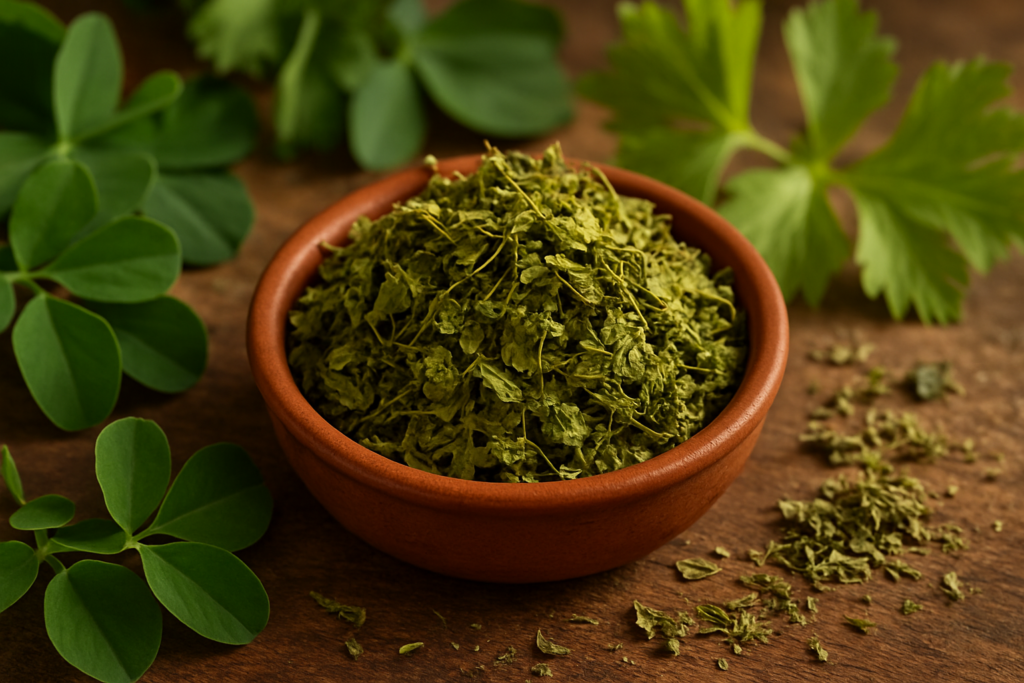
Kasuri methi (dried fenugreek leaves) adds a distinctive bitter, slightly sweet, herbal depth to Indian dishes. When you run out mid-recipe, the right substitute depends on what you have available and which dish you’re making. This guide covers 9 replacements with exact ratios — from fresh methi to celery leaves to fenugreek seeds — so your dish tastes as close to the original as possible.
Quick Reference: Kasuri Methi Substitute at a Glance
- Prep Time: 5 minutes
- Cook Time: 0 minutes (substitution guide)
- Total Time: 5 minutes
- Serves: Use these ratios for any recipe serving 2-6 people
Kasuri methi (dried fenugreek leaves) adds a distinctive bitter, slightly sweet, herbal depth to Indian dishes. This guide covers 9 tried-and-tested substitutes with exact ratios — from fresh methi to celery leaves to fenugreek seeds — so your dish tastes as close to the original as possible, even when you’re running on an empty spice jar.
Why Kasuri Methi Is So Hard to Replace (And Why It Matters)
Before we dive into substitutes, let me explain what we’re actually trying to replicate. Fenugreek (Trigonella foenum-graecum) is one of the oldest cultivated plants in the world, and kasuri methi — which gets its name from the Kasur region of Punjab (now in Pakistan) — is simply the dried leaf form. When you crush kasuri methi between your palms and drop it into a hot dish at the end of cooking, it releases three distinct qualities:
- A gentle bitterness — think of it like a softer, leafier version of the seed’s bitterness
- A slightly sweet, maple-like undertone — this comes from the compound sotolone, which is also found in maple syrup
- A dry, aromatic herbiness — floral and earthy at the same time
No single substitute replicates all three perfectly. But with the right combination and ratio, you can get very, very close. That’s what we’re going to do today.
Why You’ll Love Having These Kasuri Methi Substitutes Ready
- Never get stuck mid-recipe again — knowing these swaps means you can cook confidently even with a half-stocked pantry
- Most substitutes are already in your kitchen — celery, fresh methi from your balcony garden, or even fenugreek seeds you use for tadka
- Works for Indian diaspora cooks everywhere — Indian grocery stores aren’t always around the corner
- Exact ratios take out the guesswork — no more over-substituting and making your curry taste like a salad
- Covers Jain, vegan, and gluten-free cooking needs — every substitute listed here is vegetarian and most are naturally gluten-free
Ingredients You’ll Need (The Substitutes Themselves)
Here’s a complete list of what each substitute is, where to find it, and what to do if you’re abroad and can’t find the Indian version:
- Fresh fenugreek leaves (fresh methi): Available at Indian grocers. In the UK, US, Canada, and Australia, you’ll often find these at South Asian or Middle Eastern grocery stores. In a pinch, you can grow methi from fenugreek seeds on your windowsill — it sprouts in 5-7 days!
- Dried celery leaves: The most accessible substitute outside India. Many Western supermarkets carry dried celery flakes or celery seasoning. Check the herbs and spices aisle. Substitute ratio: 1:1.
- Fresh celery leaves: The leafy tops of a celery bunch — most people throw these away! Don’t. They’re herby, slightly bitter, and work beautifully. Ratio: 1.5x the kasuri methi called for.
- Fenugreek seeds (methi dana): Almost always available at Indian grocery stores worldwide, and even in the spice aisle of larger Western supermarkets. Use very sparingly — 1/4 tsp per 1 tbsp kasuri methi — and lightly crush before using.
- Dried mustard greens (sarson): Available in Indian stores and Chinese/Asian grocery stores. 1:1 ratio.
- Maple syrup: Yes, really. A tiny amount (1/4 tsp per tbsp of kasuri methi) mimics the bittersweet sotolone note. Use only as a flavour bridge alongside another substitute, not on its own.
- Dried watercress: Available at health food stores and online. 1:1 ratio.
- Alfalfa sprouts (dried): Available at health food stores. 1:1 ratio. Milder than kasuri methi but adds the herby quality.
- Curry leaves (fresh or dried): Widely available at Indian stores. Note: the flavour is distinctly South Indian and different — use this only when making South Indian dishes or when you truly have nothing else. 1:1 ratio by volume.
The 9 Best Kasuri Methi Substitutes — With Exact Ratios
1. Fresh Fenugreek Leaves — The Best Dried Fenugreek Leaves Substitute
Ratio: 3 tablespoons fresh methi = 1 tablespoon kasuri methi
This is the gold standard. Fresh methi leaves and kasuri methi come from the same plant — you’re just compensating for the concentration difference caused by drying. Fresh leaves have a higher water content, so you need three times as much to get the same intensity of flavour.
Roughly chop the fresh methi and lightly sauté it in a dry pan on low heat for 2-3 minutes until it wilts and dries slightly. This concentrates the flavour and gets you even closer to kasuri methi’s profile. Add it at the same stage you’d add kasuri methi — as a finishing herb, not at the beginning of cooking.
Some cooks add fresh methi right at the start with the onions, and that works too, but for substitution purposes, wilting it separately and adding at the end gives you that distinctive kasuri methi finish.
2. Dried Celery Leaves — The Easiest Kasuri Methi Replacement Abroad
Ratio: 1:1 (1 tablespoon dried celery leaves = 1 tablespoon kasuri methi)
Dried celery leaves have a slightly bitter, herbaceous quality that’s genuinely close to kasuri methi. They won’t fool a fenugreek superfan, but in a rich dal makhani or a creamy paneer gravy, the difference is minimal.
Always crush the dried celery leaves between your palms before adding — just like you would with kasuri methi. This releases the volatile aromatic oils and makes a real difference to the final fragrance.
3. Fresh Celery Leaves — Your Grocery Store Secret Weapon
Ratio: 1.5 tablespoons fresh celery leaves = 1 tablespoon kasuri methi
The leafy tops of a celery bunch are bitter, herby, and completely underrated. Chop them finely and use 1.5x the amount of kasuri methi called for. Best added in the last 2 minutes of cooking so the delicate flavour doesn’t cook off completely.
4. Fenugreek Seeds (Methi Dana) — The Pantry Staple Workaround
Ratio: 1/4 teaspoon fenugreek seeds = 1 tablespoon kasuri methi
Methi dana is a common instinct as a substitute, but use it very sparingly. Fenugreek seeds are significantly more bitter and pungent than the dried leaves. The 1/4 teaspoon per tablespoon ratio might seem tiny, but it’s the right call.
Lightly crush the seeds in a mortar or with the back of a spoon before adding. This works best in thick gravies, dals, and lentil dishes — not for finishing flatbreads or parathas where you want a leafy texture.
5. Dried Mustard Greens (Sarson) — For North Indian Dishes Especially
Ratio: 1:1
Dried sarson has a peppery, slightly bitter quality that works well as a kasuri methi substitute in North Indian dishes. It’s particularly good in gravies and parathas. You can find dried sarson powder or dried sarson leaves at most Indian grocery stores. The flavour is bolder, so start with 3/4 of the amount and adjust.
6. Maple Syrup — The Surprising Flavour Bridge
Ratio: 1/4 teaspoon maple syrup per 1 tablespoon kasuri methi (use alongside another substitute)
The compound sotolone is responsible for kasuri methi’s faint bittersweet, almost caramel-like undertone — and it’s the same compound found in maple syrup. A tiny amount of maple syrup used alongside dried celery leaves replicates that elusive sweetness that makes kasuri methi so special in creamy gravies like paneer butter masala or shahi paneer.
Add just 1/4 teaspoon to your gravy along with the celery leaves, stir, and taste. Fenugreek’s unique flavour compounds are genuinely complex, and this two-part approach is the closest you’ll get without the real thing.
7. Dried Watercress — The Health Food Store Find
Ratio: 1:1
Watercress has a peppery bitterness that works reasonably well as a dried fenugreek leaves substitute. Dried watercress, available at health food stores and online, crushes well and releases a pleasant herby aroma. It’s slightly more pungent than kasuri methi, so start with 3/4 of the amount and add more to taste.
8. Alfalfa Sprouts (Dried)
Ratio: 1:1
Milder than most other substitutes, dried alfalfa adds a gentle herby quality without too much bitterness. This works best in milder dishes — think creamy white gravies, mild vegetable kormas, or as a finishing garnish on dal. It won’t give you kasuri methi’s full punch, but it’s a nice background note.
9. Curry Leaves (Fresh or Dried) — Last Resort Only
Ratio: 1:1 by volume
Curry leaves and fenugreek leaves taste nothing alike — the flavour profile is completely different. Curry leaves are distinctly South Indian, citrusy, and fragrant in a different way. But if you’re making a South Indian dish and you’re out of kasuri methi, curry leaves add an aromatic herby layer that serves a similar functional purpose. For North Indian dishes, I’d honestly rather skip the kasuri methi entirely than use curry leaves as a substitute.
Tips for Perfect Kasuri Methi Substitution Every Time
- Always crush between your palms: Whether you’re using the real thing or any substitute, crushing releases volatile aromatic oils. This single step makes the biggest flavour difference. Rub the dried leaves firmly between your palms right over the pot just before adding.
- Add at the end of cooking: Kasuri methi is a finishing herb. Its delicate aromatics cook off quickly. The same applies to most substitutes — add in the last 1-2 minutes of cooking for maximum fragrance.
- Start with less, taste, then add more: Every substitute has a slightly different intensity. Start with 3/4 of the recommended ratio, taste your dish, and adjust. You can always add more; you can’t take it out.
- Combine two substitutes for complex flavour: A particularly effective combination is dried celery leaves + a tiny pinch of maple syrup. Together they mimic both the herby bitterness and the bittersweet note of kasuri methi far better than either does alone.
- Make your own kasuri methi in advance: When fresh methi is in season (winter in India), buy a large bunch, dry the leaves completely (air-dry for 48 hours or oven-dry at 50°C for 2-3 hours), and store in a sealed jar. Home-dried kasuri methi lasts 2-3 months and is often more fragrant than the store-bought version.
Variations — Jain, Vegan, and Gluten-Free Substitutes
Jain-Friendly Kasuri Methi Substitute
Good news for Jain cooks — all the substitutes listed above (dried celery leaves, fresh celery leaves, dried watercress, alfalfa) are Jain-permissible. Fenugreek seeds are also Jain-friendly. Just double-check any store-bought spice blends or mixed herb packets for garlic or onion powder, which are sometimes added as fillers.
Vegan-Friendly
Every single substitute in this guide is 100% plant-based and vegan. The maple syrup trick is also vegan (unlike honey, which some people mistakenly use).
Gluten-Free
All substitutes listed are naturally gluten-free. If you’re using a pre-packaged dried herb blend, check the label for any wheat-based fillers or anti-caking agents, which are occasionally found in cheap spice blends.
No-Onion-No-Garlic Version
All substitutes work perfectly in no-onion-no-garlic (satvik) cooking. The substitution ratios remain the same regardless of whether your dish contains onion and garlic or not.
What to Serve With Dishes That Use Kasuri Methi (or Its Substitute)
Kasuri methi and its substitutes show up most often in these dishes — and here’s what goes beautifully with them:
- Paneer butter masala or palak paneer: Serve with homemade garlic naan or jeera rice — both soak up the kasuri methi-scented gravy beautifully.
- Dal makhani or dal tadka: A kasuri methi-finished dal is perfect with laccha paratha and a small bowl of raw onion rings with lemon.
- Methi aloo or methi paratha: Serve with fresh dahi (yoghurt) and a simple kachumber salad. The cool yoghurt balances the bitterness of the methi beautifully.
Storage and Reheating
This section applies both to kasuri methi itself and to your substitute herbs:
- Store dried herbs in airtight jars away from direct sunlight and heat — your spice drawer is perfect, but not the shelf directly above your stove (too much heat and steam).
- Dried celery leaves and dried watercress last 6-12 months in a sealed jar.
- Fresh methi leaves last 4-5 days in the refrigerator wrapped in a damp cloth inside a container. You can also blanch and freeze fresh methi — it lasts 2-3 months in the freezer and can be used directly from frozen in cooked dishes.
- Homemade kasuri methi lasts 2-3 months at room temperature in an airtight jar, or up to 6 months if refrigerated.
- Dishes made with kasuri methi substitutes reheat exactly the same way as regular kasuri methi dishes — on the stovetop over low-medium heat with a splash of water, or in the microwave in 90-second bursts, stirring in between.
Frequently Asked Questions About Kasuri Methi Substitute
Can I use fresh methi instead of kasuri methi?
Yes, absolutely! Fresh methi is actually the best kasuri methi substitute if you can find it. Use 3 tablespoons of fresh, finely chopped methi leaves for every 1 tablespoon of kasuri methi the recipe calls for. The flavour is less intense and slightly less bitter, but the character is the same. Lightly wilting the fresh leaves in a dry pan for 2-3 minutes before using gets you even closer to the dried version.
What is the fresh methi to kasuri methi conversion ratio?
The standard fresh methi to kasuri methi conversion ratio is 3:1. That means 3 tablespoons of fresh fenugreek leaves = 1 tablespoon of kasuri methi. This is because dried kasuri methi is significantly more concentrated in flavour and aroma than fresh leaves. If you’re converting the other way — making kasuri methi at home from fresh leaves — expect about 1 cup of fresh leaves to yield roughly 3-4 teaspoons of dried kasuri methi.
Is there a kasuri methi substitute that works specifically for paneer butter masala or creamy gravies?
For creamy, rich gravies like paneer butter masala or dal makhani, the best kasuri methi substitute is dried celery leaves (1:1 ratio) combined with a tiny pinch of maple syrup (1/4 tsp per tablespoon). The celery leaves bring that herbal, slightly bitter note, and the maple syrup mimics kasuri methi’s faint bittersweet warmth that balances rich cream-based sauces. The sotolone compound shared by both fenugreek and maple syrup is what makes this combination work.
Can I make kasuri methi at home from fresh fenugreek leaves?
Yes, and it’s very easy! Pick fresh methi leaves off the stems, wash them thoroughly, and spread on a clean kitchen towel. Let them air-dry for 24-48 hours, or spread on a baking tray and dry in your oven at the lowest setting (around 50-60°C / 120-140°F) for 2-3 hours with the door slightly ajar. Once completely dry and crumbly, store in an airtight jar. Homemade kasuri methi stays fragrant for 2-3 months and often smells better than most store-bought versions.
Does kasuri methi have any substitutes that are gluten-free and Jain-friendly?
Almost all kasuri methi substitutes are naturally gluten-free. For Jain cooking (which avoids root vegetables and certain underground produce), dried celery leaves, dried watercress, and fresh celery leaves are all excellent Jain-friendly kasuri methi substitutes. Fenugreek seeds (methi dana) are also Jain-permissible. Just avoid any store-bought spice blends that might contain garlic or onion powder as fillers.



2 thoughts on “Kasuri Methi Substitute: 9 Best Replacements for Dried Fenugreek Leaves (With Exact Ratios)”