
Besan Ladoo Recipe: The Perfect Way to Roast Gram Flour So Your Ladoos Set Every Time
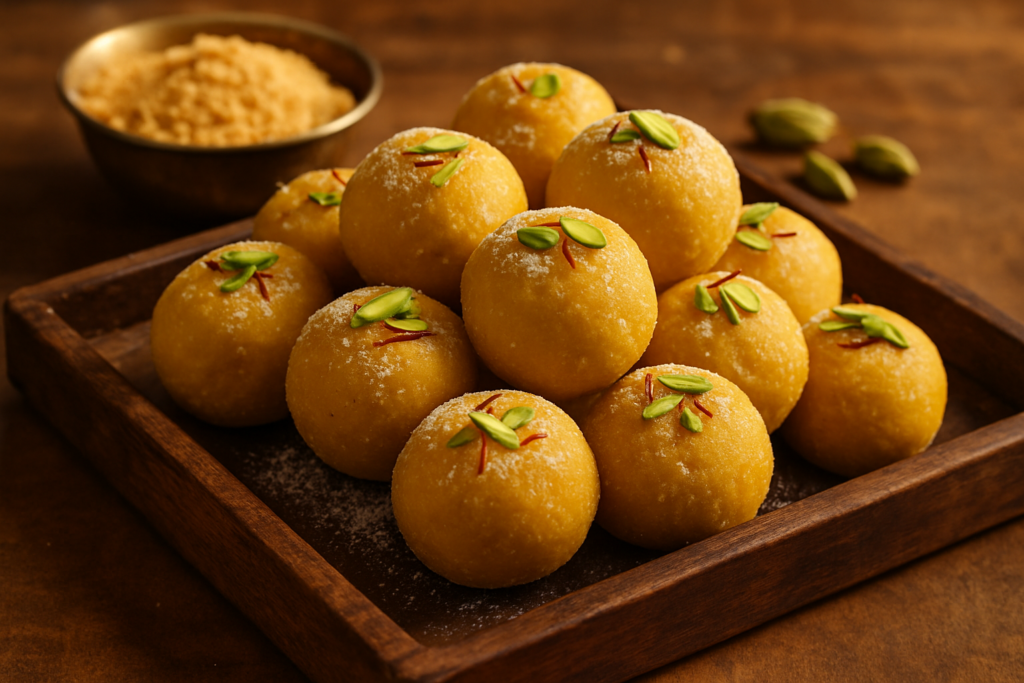
Besan ladoo depends almost entirely on getting the roasting right. Roast the gram flour properly — to deep golden amber, fully nutty-smelling, and smooth between your fingers — and the ladoos will set firmly every time. Roast it too little, and no amount of sugar or cardamom will save them. Here is a complete guide to the roasting process and every step after it.
What no recipe explains clearly is that besan roasting is entirely a sensory process. There’s a very specific color, a very specific smell, and a very specific texture that tells you it’s done. Get that right, and the ladoos will be perfect every time. Get it wrong, and no amount of sugar or cardamom will save them.
Quick Recipe Overview
- Prep Time: 15 minutes
- Cook Time: 30 minutes
- Total Time: 45 minutes (plus 20-30 min resting)
- Servings: 18-20 medium ladoos
- Difficulty: Easy-Intermediate
This classic besan ladoo recipe uses gram flour slow-roasted in pure ghee until deep golden and nutty, then mixed with powdered sugar and cardamom and shaped into beautiful golden balls. The key is patience during roasting — rush that step and your ladoos won’t set.
Why You’ll Love This Besan Ladoo Recipe
- Completely foolproof once you understand the roasting cues — colour, smell, and texture checkpoints so there’s no guesswork
- No fancy equipment needed — just a heavy kadai, a spatula, and your nose
- Stores for 2 weeks at room temperature — perfect for making ahead for festivals
- Naturally gluten-free — made from gram flour, not wheat
- Only 5 core ingredients — besan, ghee, sugar, cardamom, and cashews. That’s it.
Ingredients You’ll Need
- Fine besan (gram flour), 2 cups / 200g — Use the fine variety, not coarse. In India, look for the type labeled “ladoo besan” or “fine chakki besan.” If you’re outside India, gram flour (also called chickpea flour) from any South Asian grocery store works perfectly. Bob’s Red Mill chickpea flour is a decent substitute if that’s all you can find, though the texture will be very slightly different.
- Pure ghee, 1/2 cup / 110g — Do not substitute butter here. Ghee has a higher smoke point and gives a distinct richness that is non-negotiable in this recipe. If you’re in the US, Purity Farms or Organic Valley make good ghee.
- Powdered sugar (boora or tagar), 3/4 cup / 90g, sifted — Traditional recipes use boora, which is unrefined powdered sugar with a slight graininess and caramel note. Store-bought icing/confectioner’s sugar works perfectly well for a smoother texture. Don’t skip sifting — lumps make uneven ladoos.
- Green cardamom powder, 1/2 tsp — Please grind your own from whole pods. Pre-ground cardamom from a year-old jar is flavour sadness. About 5-6 pods will give you the half teaspoon you need.
- Raw cashews, 2 tbsp, roughly chopped — Adds texture and a lovely richness. Sub with almonds or skip entirely for a nut-free version.
- Raisins, 2 tbsp (optional)
How to Roast Besan for Ladoo — The Step-by-Step Guide
How to roast besan for ladoo is genuinely the most important skill in this entire recipe. The ratios are fairly standard across recipes, but without knowing what “properly roasted” actually looks like, the batch will fail. Here’s the complete picture before starting:
The Three Doneness Signals for Roasted Besan:
1. Colour: It should shift from pale yellow to a deep, warm golden amber — think the colour of raw turmeric or aged wood.
2. Smell: The raw, slightly bitter chickpea smell will completely disappear and be replaced by an intensely nutty, almost caramel-like aroma. You’ll physically want to eat it off the spoon.
3. Texture: A pinch pressed between your fingers should feel smooth and slightly oily — zero grittiness. If it still feels grainy, it needs more time.
Melt the ghee on low heat. Place your heaviest kadai or wide pan on the lowest flame your stove allows. Add the half cup of ghee and let it melt completely. The pan should be warm, not smoking hot — medium-low at the absolute highest. High heat is the enemy of this recipe.
Add the besan and start stirring. Tip all the besan into the melted ghee at once. It will look like a thick, unappetising paste immediately — that’s completely normal. Start stirring right away with a wide spatula or wooden spoon, scraping the bottom and sides of the pan to prevent any sticking.
The first 10 minutes — patience mode. Keep stirring continuously on low heat. Around the 8-10 minute mark, you’ll notice the mixture starts to loosen slightly (the ghee is warming the besan and helping it cook through) and it will begin to smell mildly nutty. The colour will still be pale-ish yellow. Keep going — it’s not done.
The next 15-20 minutes — this is where the magic happens. Continue roasting and stirring without stopping. The mixture will gradually deepen in colour, moving through pale gold, to gold, to a rich amber. The raw chickpea smell will completely disappear. Somewhere around the 20-25 minute mark total, you’ll see ghee beginning to pool and separate slightly around the edges of the mixture. That’s your strongest visual cue that it’s nearly there.
The finger test. Take a tiny amount on a spoon, let it cool for 10 seconds, then press it between your thumb and index finger. It should feel completely smooth and slightly glossy — no grittiness whatsoever. If it’s still gritty, keep roasting for another 3-5 minutes and test again.
Add the nuts and take it off the heat. Once you’re satisfied it’s done, add the chopped cashews and raisins directly into the hot mixture. Stir them in — the residual heat will gently toast the cashews. Remove the kadai from the stove immediately.
The crucial cooling window — don’t skip this. Let the mixture cool for exactly 10-12 minutes. Set a timer. You want it warm to the touch but not hot — the surface temperature you’d want for a cup of tea you’re about to drink. Too hot, and the heat will melt your powdered sugar into a syrup, making sticky, flat ladoos. Too cool, and the mixture won’t be pliable enough to roll into smooth balls.
Add the sugar and cardamom. Sift the powdered sugar and cardamom powder directly into the warm besan mixture. Mix thoroughly until no white streaks remain. The mixture should come together and look uniformly golden-brown.
Roll the ladoos. Lightly grease your palms with a tiny drop of ghee. Scoop about 2 tablespoons of the mixture (a cookie scoop works well for consistency) and press it firmly between both palms, rolling in circular motions. Apply firm, even pressure — don’t be gentle or they’ll crumble. Place on a plate.
Garnish and rest. Press a pistachio sliver onto each ladoo. Let them rest undisturbed at room temperature for 20-30 minutes. They’ll firm up beautifully as they cool.
Tips for Perfect Besan Ladoo Every Time
- Low and slow is the only way. High heat roasts the outside of the besan particles while leaving the inside raw, which means you’ll get brown specks but a still-raw flavour — and ladoos that won’t set properly. Low heat roasts everything evenly.
- Never walk away from the kadai. Besan can go from perfectly golden to scorched in under 60 seconds if left unattended, especially as it gets closer to done. Keep stirring continuously.
- Weigh your ingredients. Especially the sugar. Too much sugar and the ladoos will be soft and won’t hold shape; too little and they’ll be dense.
- Don’t add sugar to hot besan. Adding powdered sugar to besan that’s too hot will partially melt the sugar and give you ladoos with a sticky, wet interior that never properly sets. The 10-12 minute rest is non-negotiable.
- If the mixture is too dry to roll — add 1 teaspoon of warm ghee at a time and mix well. If it’s too sticky — it was likely either too hot when you added the sugar, or the besan was under-roasted. Pop the mixture in the fridge for 10 minutes; it should firm up enough to roll.
Fixing Besan Ladoo That Isn’t Setting — Common Problems
- Ladoos crumbling after rolling: Besan was under-roasted. The unroasted proteins in the flour don’t bind the same way. Nothing will fix this completely after the fact, but adding 1-2 tsp of warm ghee and mixing again may help slightly. Next time, roast longer.
- Ladoos are too sticky and won’t hold shape: Sugar was added when the mixture was too hot, or there’s too much ghee. Refrigerate the mixture for 15-20 minutes and try rolling again with chilled, dry palms.
- Ladoos are too hard after setting: Either the mixture cooled too much before rolling, or there’s too little ghee. Warm the mixture very briefly (10-15 seconds in the microwave) and try again.
There’s a more detailed troubleshooting guide in the post on fixing common Indian mithai problems for those who want to go deeper on this.
Variations of This Besan Ladoo Recipe
Jain / No-Onion-No-Garlic Version
Great news — this recipe is already completely Jain-friendly. Besan ladoos contain no onion, garlic, or root vegetables. Just ensure your ghee is from a brand acceptable per your personal observance.
Vegan Besan Ladoo
Substitute the ghee with an equal quantity of refined coconut oil. The ladoos will be slightly softer at warm room temperatures and the flavour will have a mild coconut undertone, but they will still be delicious and will set properly if refrigerated for 10 minutes after rolling.
Sugar-Free / Diabetic-Friendly Version
I know purists will disagree with me here, but powdered erythritol works reasonably well as a 1:1 substitute for powdered sugar in this recipe. The texture is slightly different (a touch drier), but the ladoos set well and the flavour is very close. Stevia doesn’t work — the ratio is completely different and the aftertaste is noticeable.
Roasted Nut Variation
For a richer, more festive version, add 2 tbsp of finely ground roasted almonds and 1 tbsp of desiccated coconut along with the sugar.
What to Serve With Besan Ladoo
- As part of a Diwali mithai thali alongside homemade kaju katli and coconut barfi — the contrast of textures and flavours is lovely.
- With masala chai — the nuttiness of the ladoo and the spiced warmth of the tea is one of those combinations that just makes sense on a cold evening.
- As prasad for puja — besan ladoos are among the most traditional prasad offerings across many Hindu festivals, particularly for Ganesh Chaturthi.
Storage and Reheating
- Room temperature: Store in an airtight container for up to 2 weeks. Place a small food-safe silica gel packet inside if you live in a humid climate — this prevents the surface from becoming sticky.
- Refrigerator: Up to 4 weeks. The ladoos will harden slightly in the fridge — take them out 30 minutes before serving to come back to room temperature.
- Freezer: Besan ladoos freeze beautifully for up to 2 months. Place them in a single layer on a tray, freeze until solid (about 1 hour), then transfer to a zip-lock bag. Thaw at room temperature for 2-3 hours before serving. No reheating needed — they’re best at room temperature.
- Do not microwave to reheat — it makes them sticky and unpleasant. Room temperature thawing is always the right call.
For more information on the nutritional profile of gram flour and why it’s such a nutritionally rich ingredient, Healthline has a detailed breakdown of chickpea flour’s health benefits that’s well worth a read.
And if you loved this recipe and want to explore more Indian sweets at home, do check out the guide to easy Indian mithai recipes for beginners — it’s a great starting point if you’re new to making sweets from scratch.
Frequently Asked Questions
Why are my besan ladoos not setting or falling apart?
This is almost always a roasting issue. Under-roasted besan doesn’t bind properly, and the ladoos crumble. Make sure you roast until the mixture is deep golden, smells nutty, and the ghee visibly separates at the edges. Also, check that you’re shaping them while the mixture is warm — not too hot, not fully cooled. Rolling temperature is almost as important as roasting time.
How do I know exactly when the besan is perfectly roasted for ladoo?
Three signs together confirm it: the colour turns deep golden amber (similar to raw turmeric), the raw flour smell completely disappears and is replaced by a rich, toasted nutty aroma, and a small pinch pressed between your fingers feels smooth with no gritty texture whatsoever. Ghee visibly pooling at the edges of the mixture is the final confirmation. All three together — you’re done.
Can I use store-bought powdered sugar instead of boora or tagar?
Yes, absolutely. Regular store-bought icing sugar (confectioner’s sugar) works perfectly fine, especially for those making this outside India. Traditional recipes use boora — unrefined powdered sugar — which gives a slightly grainier texture and a more authentic caramel undertone, but the difference in a home batch is minimal. Make sure you sift it either way.
Can I make this besan ladoo recipe without ghee — a vegan version?
Ghee is really the soul of this recipe and I won’t pretend otherwise — it’s what gives that characteristic richness and helps the besan roast evenly. That said, refined coconut oil can work as a substitute using the same quantity. The flavour will be mildly coconutty and the ladoos may be a touch softer at room temperature, but they will still set and taste genuinely delicious. Avoid vegetable oil — it doesn’t give the same binding properties.
How long do besan ladoos stay fresh, and do they need refrigeration?
Besan ladoos store beautifully at room temperature in an airtight container for up to 2 weeks — one of the reasons they’re such a popular festive mithai to make in advance. In summer months or in climates above 35°C, refrigerate them and bring to room temperature before serving. They also freeze exceptionally well for up to 2 months, making them ideal for preparing weeks ahead of festivals.
One thought on “Besan Ladoo Recipe: The Perfect Way to Roast Gram Flour So Your Ladoos Set Every Time”