
Kaju Katli Recipe: Perfect Smooth, Crack-Free Cashew Fudge at Home
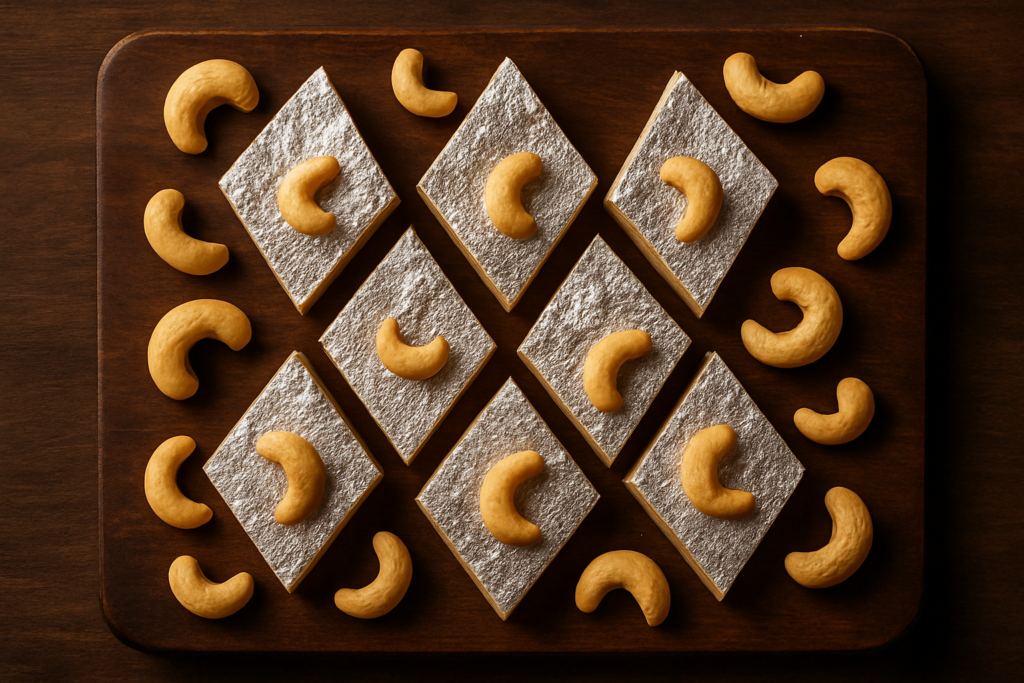
Kaju katli is one of the most popular Indian festival sweets, and it is achievable at home in about 35 minutes with five ingredients. The technique comes down to two moments: hitting an exact one-string sugar syrup, and pulling the dough off the heat while it is still soft and pliable. Get those right and the result is smooth, crack-free, diamond-shaped cashew fudge every time. This kaju katli recipe walks through every detail, including why katli cracks and how to apply silver leaf without tearing it.
Why You’ll Love This Kaju Katli Recipe
- Only 5 real ingredients — cashews, sugar, water, ghee, and cardamom. That’s it. No condensed milk, no khoya, no shortcuts that compromise the authentic texture.
- Ready in 30 minutes — faster than driving to a mithai shop, and infinitely more satisfying.
- No special equipment needed — a heavy-bottomed pan, a wooden spatula, and a rolling pin is all you need.
- Perfect for gifting — homemade kaju katli in a pretty box with silver leaf is honestly one of the most thoughtful festival gifts you can give.
- Naturally gluten-free — great for guests with gluten sensitivities.
Prep Time: 15 minutes | Cook Time: 20 minutes | Total Time: 35 minutes | Servings: 25 pieces
This kaju katli recipe uses finely ground cashew powder cooked with a one-string sugar syrup to create smooth, firm, diamond-shaped sweets. The key is pulling the dough off the heat at exactly the right moment — soft, pliable, and matte — then rolling and cutting while still warm.
Ingredients You’ll Need for This Cashew Barfi Recipe
- Raw cashews (kaju): 2 cups / 250g. Use plain, unsalted, unroasted cashews. Whole ones grind more evenly than broken pieces. If you’re in the UK or US, look in Indian grocery stores or on Amazon. Regular supermarket cashews work fine as long as they’re not salted or roasted.
- Sugar: 1 cup / 200g. Plain white granulated sugar is perfect. Do not use caster sugar (it dissolves too fast and makes the syrup stage harder to judge) or brown sugar (will change the colour and flavour).
- Water: ½ cup / 120ml. Just enough to dissolve the sugar.
- Ghee: 1 teaspoon, plus extra for greasing. Don’t skip this. It adds richness and helps the dough release cleanly. Vegan? Use refined coconut oil instead.
- Cardamom powder: ¼ teaspoon. Freshly ground from green cardamom pods is a hundred times better than store-bought powder, but use what you have.
- Rose water or kewra water: 1 teaspoon, optional. I know purists will say kaju katli doesn’t need it, but honestly, a tiny splash of kewra water gives it that classic mithai-shop aroma.
- Edible silver leaf (varak): Optional but traditional. You can find it in Indian sweet shops or well-stocked Indian grocery stores. If you can’t source it, crushed pistachios or dried rose petals look equally beautiful.
How to Make Kaju Katli at Home — Step by Step
- Grind your cashews first. Make sure your cashews are completely dry and at room temperature — any moisture will ruin the texture. Add them to a dry blender or food processor and grind in short pulses until you get a fine powder. Stop before it turns into a paste (the heat from the blades will release the oils and you’ll end up with cashew butter). Sieve the powder and re-grind any chunky bits. Set aside.
- Make the sugar syrup. In a heavy-bottomed pan (non-stick works best here), combine the sugar and water. Stir once to mix, then bring to a boil over medium heat without stirring again — stirring causes crystallisation and a grainy final product. Let it cook until you reach a one-string consistency: dip a spoon, let a drop cool on a plate for 10 seconds, touch it between your thumb and forefinger, pull apart gently — one clean thread should form and hold without breaking. This usually takes 5–7 minutes from when it starts boiling. Trust your instincts, not just the clock.
- Add the cashew powder. The moment you’ve hit that one-string stage, immediately reduce the heat to the absolute lowest setting. Add the cashew powder all at once and stir briskly with a wooden spatula. It will look lumpy and weird for the first 30 seconds — don’t panic, keep going. Add the ghee and cardamom powder now and stir them in.
- Cook the dough to the right stage. Stir continuously in a figure-eight motion, making sure to scrape the sides and bottom so nothing catches and burns. Within 5–8 minutes the mixture will come together into a smooth, soft dough that pulls cleanly away from the sides of the pan. It should look matte rather than glossy when it’s ready. Add rose water or kewra water now, mix in quickly. Remove from heat immediately. This is the most critical step — 30 seconds too long on the heat is the difference between perfect katli and crumbly disaster.
- Transfer and knead briefly. Scoop the hot dough immediately onto a parchment-lined tray that you’ve lightly greased with ghee. Grease your palms. Gently knead for about 30 seconds while the dough is still warm — just enough to smooth it out and remove any lumps. Don’t over-knead or it’ll get oily.
- Roll it out. Place another sheet of greased parchment on top and roll out to about 5–6mm thickness using a greased rolling pin. Roll evenly in all directions and try to get it into a rough rectangle. If the surface starts to crack while rolling, that’s a sign it’s slightly overcooked or cooling too fast — dampen your fingertips with literally one drop of water and smooth it gently over any cracks.
- Apply silver leaf and cut. Let the rolled dough cool at room temperature for 15–20 minutes until it firms up but is still slightly warm to the touch. If you’re using silver leaf (varak), this is the time — place the sheet tissue-side up, press very gently with your fingertips, then peel back the tissue slowly. The varak will transfer to the surface. Then, using a sharp knife or pizza cutter, cut into classic diamond (rhombus) shapes. Clean your knife between cuts for those sharp, clean edges.
- Cool completely before storing. Let the pieces sit at room temperature for at least 30 minutes before packing — they firm up further as they cool and taste even better once they’ve settled.
Tips for Perfect Kaju Katli Every Time
The One-String Test Is Non-Negotiable
A thermometer can be used (236°F / 113°C is the target soft-ball stage) and it works, but the old-fashioned string test is more reliable for this recipe because every stove and pan behaves differently. Practice it a couple of times and you’ll never second-guess yourself again.
Grind in Batches, Don’t Rush It
If you overcrowd your blender, the cashews at the bottom get warm and start releasing oil. Grind in two batches if needed, and keep the grinder going in short pulses with rests in between. Cold cashews grind better — chilling them in the fridge for 20 minutes first helps.
Work Quickly Once the Dough Is Ready
The dough sets fast. Have your parchment paper, rolling pin, and tray ready before you even turn on the stove. Once you take the pan off the heat, you have maybe 2 minutes to get it transferred and rolling before it starts to firm up too much to work with comfortably.
Why Does Kaju Katli Crack — and How to Prevent It
Cracking happens for three main reasons: the sugar syrup went past one-string into a harder stage, the dough was cooked too long in the pan and dried out, or the dough was rolled after it had already cooled down and stiffened. The fix for all three is the same: work faster, catch the dough earlier, and always roll while it’s still warm and pliable. If your dough does crack, a tiny dab of warm water smoothed over the surface before rolling again can often save it.
Use a Silicone Mat if You Have One
Rolling on a silicone mat gives the most even surface and nothing sticks. It’s a game-changer for this kaju katli recipe. If you don’t have one, greased parchment paper works perfectly well.
Variations of This Kaju Katli Recipe
Jain / No-Onion-No-Garlic Version
Good news — this recipe is already 100% Jain-friendly. No onion, no garlic, no root vegetables. Make it exactly as written.
Vegan Kaju Katli
Replace the ghee with an equal amount of refined coconut oil (not virgin — the coconut flavour will overpower the cashews). Everything else stays the same. The texture is nearly identical and it sets beautifully.
Saffron Kaju Katli
Dissolve a generous pinch of saffron strands in the water before making your sugar syrup. The result is a pale gold colour and a subtle floral flavour that looks stunning on a dessert table.
Chocolate Kaju Katli
I know, I know — purists, please look away. But adding 2 tablespoons of unsweetened cocoa powder along with the cashew powder produces a chocolate cashew fudge with a dramatic finish. Top with gold leaf instead of silver.
Pistachio-Topped Kaju Katli (No Silver Leaf Version)
If you can’t find edible silver leaf, finely chop or crush some bright green pistachios and press them gently onto the surface just before cutting. The green against the ivory is really beautiful and tastes wonderful too.
What to Serve With This Cashew Barfi
- As part of a Diwali mithai box: Pair alongside homemade besan ladoo and coconut barfi for a classic festive spread.
- With masala chai: The slight saltiness of a strong ginger-cardamom chai cuts through the sweetness of kaju katli beautifully. It’s the perfect afternoon combination.
- As a gifting platter: Arrange pieces on a small decorative tray with gulab jamun, dry fruits, and a small diya. Wrap in cellophane and tie with a string — one of the most thoughtful homemade gifts you can give during any Indian festival.
Storage and Reheating
At room temperature: Store in an airtight container, layering pieces between sheets of parchment or butter paper so they don’t stick together. Kaju katli stays fresh for 4–5 days at room temperature in a cool, dry place.
In the refrigerator: Keeps well for up to 2 weeks. The texture firms up when cold, so always bring to room temperature before serving — cold kaju katli loses that melt-in-mouth quality and can taste slightly waxy.
In the freezer: Yes, you can freeze it. Wrap pieces individually in cling film, place in a zip-lock bag, and freeze for up to 2 months. Thaw overnight in the fridge, then bring to room temperature before eating.
Do not reheat kaju katli in a microwave — it will melt and lose its shape. If it’s straight out of the fridge and you want to soften it slightly, just leave it on the counter for 30 minutes.
A Little More About Kaju Katli
Kaju katli — also written as kaju katari or cashew barfi — is one of the most beloved Indian sweets, traditionally associated with Diwali gifting. The name literally means “cashew slice” in Hindi. It originated in North India and has become a pan-Indian festival staple. The distinctive diamond shape, the thin profile, and the silver leaf topping make it instantly recognisable. Cashews are rich in healthy fats, magnesium, and zinc — which doesn’t make this a health food exactly, but it’s nice to know there’s some nutrition hiding in your favourite festival sweet.
Frequently Asked Questions About Kaju Katli Recipe
Why does my kaju katli crack when I cut it?
Cracking almost always happens because the mixture was cooked for too long in the pan, causing it to dry out before you could roll it. The dough needs to be caught at exactly the right moment — when it’s soft and pliable, pulls away from the pan cleanly, but still feels like warm, smooth play-dough. Another common culprit is rolling it out after it has cooled too much and stiffened. Always roll while the dough is still warm. If surface cracks appear during rolling, smooth them over gently with the tiniest amount of water on your fingertips.
Can I make kaju katli without silver leaf?
Absolutely yes. Silver leaf (varak) is purely decorative and traditional — your kaju katli will taste exactly the same without it. You can top it with finely crushed pistachios, a pinch of saffron strands, edible dried rose petals, or edible gold leaf for a beautiful finish. Or just leave it plain — the soft ivory colour is stunning on its own.
Why is my kaju katli grainy and not smooth?
Grainy texture is almost always a sugar syrup issue. Either the sugar crystallised because you stirred the syrup after it started boiling (don’t stir!), or you cooked it past the one-string stage into a harder stage. Make sure you don’t stir the boiling syrup, test the string carefully, and add the cashew powder the moment you hit that perfect one-string consistency. If crystallisation happened, unfortunately there’s no way to rescue it — but you’ll nail it next time.
Can I make this kaju katli recipe without ghee?
Yes — substitute ghee with an equal amount of refined coconut oil for a vegan version. The flavour will be slightly different but still beautiful. Avoid butter as it contains water, which will interfere with the sugar chemistry and affect the final texture. Do not skip the fat entirely — it plays an important role in making the dough smooth and helping it release from the pan.
How long does homemade kaju katli last?
Stored in an airtight container at room temperature, kaju katli stays fresh for up to 5 days. In the refrigerator, it lasts 2 weeks. In the freezer, up to 2 months. Always layer pieces between parchment paper to prevent sticking, and bring to room temperature before serving for the best texture and flavour.

One thought on “Kaju Katli Recipe: Perfect Smooth, Crack-Free Cashew Fudge at Home”