Goan Vegetarian Recipes: 15 Authentic Dishes
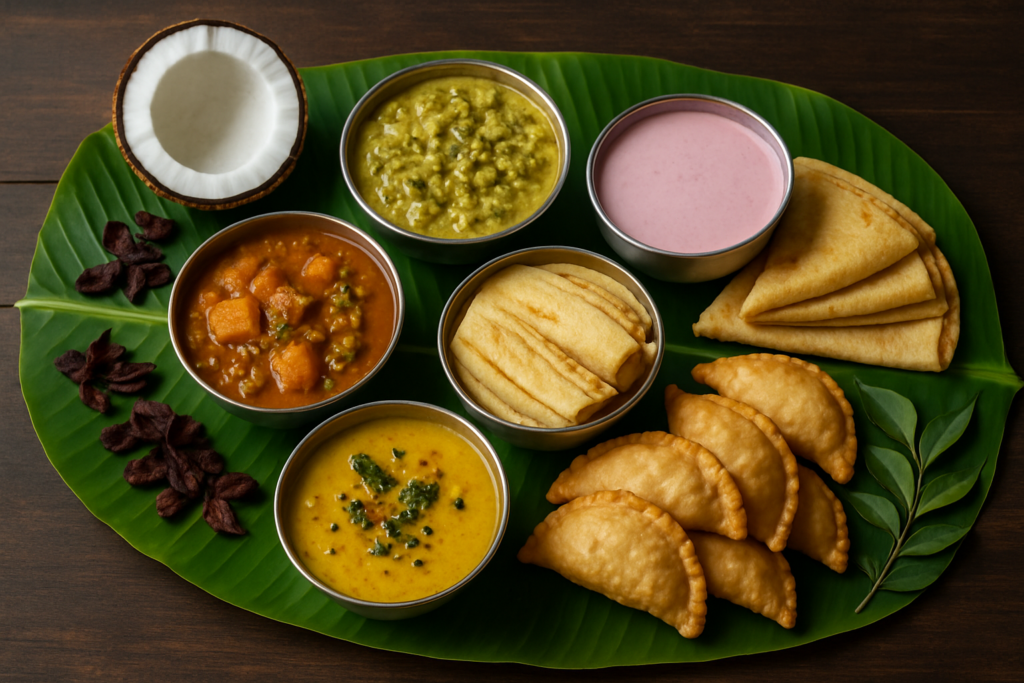
Goan vegetarian cooking—rooted in Saraswat Brahmin and Hindu Gaud households—includes coconut-based curries like khatkhate and ambat, lentil dishes, rice-based breakfast foods, and festival sweets. These 15 recipes cover the full range: soups, dals, chutneys, main curries, and desserts, all without meat or fish.
The short version
- Saraswat and Goan Hindu kitchens have a rich, independent vegetarian tradition—not a fish curry with the protein removed.
- Coconut (fresh, dried, coconut milk, coconut oil) is the structural fat and flavour base of nearly every dish.
- Kokum (Garcinia indica) is the souring agent; tamarind is used only in some regional variants.
- Goan vegetarian recipes rely on a wet masala ground fresh rather than a dry spice mix added at the end.
- Many dishes are naturally vegan; dairy appears mainly in sweets.
Why Goan vegetarian food is misunderstood
Tourism literature reduced Goan food to Goan fish curry and prawn balchão, which pushed the Saraswat Brahmin and Goud Saraswat Brahmin (GSB) vegetarian canon into near-invisibility outside the state. The GSB community did historically eat fish, but the broader Goan Hindu household tradition—particularly Daivajna and Kudumbi communities—maintained a strict vegetarian kitchen. Even within GSB homes, festival days and religious calendars meant a large repertoire of meatless and fishless cooking developed independently, not as an afterthought.
The technical foundation differs sharply from North Indian vegetarian cooking. Where a North Indian gravy often starts with onion–tomato and ends with cream or yoghurt, a Goan vegetarian curry starts with freshly ground coconut and ends with kokum or raw mango. The result is brighter, thinner, and more aromatic rather than rich and heavy.
The 15 authentic Goan vegetarian recipes
1. Khatkhate (Mixed Vegetable and Lentil Stew)
Khatkhate is the definitive Goan Hindu feast dish, made for Ganesh Chaturthi and weddings. It combines five or more vegetables—raw banana, yam, drumstick, raw jackfruit, sweet potato, colocasia—with a toor dal base and a freshly ground coconut masala that includes teppal (Sichuan pepper native to Goa’s coastal belt). The teppal is non-negotiable: it gives the broth a faint numbing citrus note that no substitute replicates. Grind coconut with red Kashmiri chillies, coriander seeds, and a small piece of teppal into a coarse paste. Cook all vegetables separately until just tender before combining, because each has a different cooking time. Add the coconut paste last and simmer for five minutes only—prolonged cooking dulls the fresh coconut flavour. The broth should be a deep brick-red, thin, and sharp on the tongue from kokum added at the end.
2. Dalitoy (Tempered Toor Dal)
Dalitoy is the GSB daily dal—toor dal cooked until fully soft, then whisked smooth and tempered with mustard seeds, dried red chillies, asafoetida, and curry leaves in coconut oil. Its defining feature is texture: thinner than North Indian dal tadka, almost soup-like. The kokum is added to the cooked dal rather than to the tempering. Two to three kokum petals are enough; more makes it aggressively sour. Serve over steamed rice with a small amount of ghee. The observable cue that the dal is correct is when it coats the back of a spoon lightly but runs off immediately—not a thick paste, not pure water.
3. Ambat (Sour Coconut Curry)
Ambat means sour, and every version of this curry leads with kokum or raw mango souring. The protein or vegetable changes—colocasia leaves, black-eyed peas, or drumstick—but the masala logic stays constant: roast coconut until golden, grind with red chillies and a small amount of coriander, then thin with water. No onion, no tomato, no garlic in the orthodox version. The finished curry should be a warm terracotta colour and thin enough to pour over rice. If it is pale, the coconut was under-roasted. If it is bitter, the coconut was burnt past the golden stage.
4. Xit Kodi (Rice and Curry, the Template)
Xit kodi is not one dish but the foundational meal pattern: steamed parboiled rice (ukda tandul) served with a thin coconut curry. For a vegetarian table, the curry is dalitoy, ambat, or a drumstick-coconut milk curry. Goan parboiled rice has a slightly firmer bite and a nutty smell absent in raw rice; this is intentional and is not a defect. Cook it in excess water, drain, and let it steam off covered for five minutes. The rice should not be sticky.
5. Tendli Bhaji (Ivy Gourd Stir-Fry)
Slice ivy gourd into thin rounds, not halved lengthways. Temper in coconut oil with mustard seeds, curry leaves, and a whole dried chilli. Add the tendli and cover on low heat for eight minutes until the vegetable softens without collapsing. Add freshly grated coconut only in the final minute so it stays moist rather than drying into a crust. The observable finish: the rounds hold their shape but yield to a fingernail without resistance.
6. Alsande Tonak (Black-Eyed Pea Curry)
Tonak refers to any Goan dry-ish curry made with a roasted coconut masala. For alsande tonak, soak and pressure-cook the peas until completely soft—any hardness in the centre means under-cooking, not intentional bite. The masala includes roasted coconut, roasted coriander seeds, a piece of cinnamon, a clove, and dried Kashmiri chillies. Roast each ingredient separately in a dry pan before grinding; grinding raw spices together produces a flat, raw-smelling paste. Thin with water until the curry coats the peas loosely rather than sitting in a pool of gravy.
7. Bharli Vaangi (Stuffed Small Aubergines)
The stuffing is a dry mixture of freshly grated coconut, jaggery, tamarind, roasted peanuts, and coriander-cumin powder. Cut each small aubergine in a cross from the base without detaching from the stem. Pack the stuffing tightly into each cross. Cook covered in coconut oil on the lowest flame, turning once, until the aubergine skin wrinkles and the interior smells sweet and caramel-roasted. Do not add water; the moisture from the aubergine itself creates enough steam. If water is added, the aubergine steams instead of slow-roasting and loses the slight char essential to the flavour.
8. Goan Solkadhi (Kokum and Coconut Milk Drink-Curry)
Solkadhi sits between a digestive drink and a curry, served alongside or after a meal. Soak six to eight dried kokum petals in a quarter cup of warm water for fifteen minutes until the water turns deep magenta. Squeeze and discard. Extract thick coconut milk from one coconut. Combine the kokum liquid with the coconut milk, salt, a crushed garlic clove, and a pinch of asafoetida. Do not cook—heat causes coconut milk to split and kokum to turn bitter. Serve at room temperature or slightly chilled. The colour should be a pale dusty pink; if it is brown, the kokum soaked too long or the coconut milk is old.
9. Mooga Gathi (Sprouted Mung Bean Curry)
Gathi is a specific Goan cooking style: the legume is first sprouted, then cooked in a coconut-based masala without souring agents. Sprout mung beans for 24–36 hours until the tail reaches half the length of the bean. Longer sprouting makes the bean too grassy and the tail goes limp. The masala uses grated coconut ground with green chillies and a little ginger—no red chilli. The final colour is pale white-green, not red. Add a tempering of mustard seeds, asafoetida, and curry leaves in coconut oil. Gathi is eaten at breakfast or as part of a festival spread.
10. Pumpkin Sasav (Pumpkin in Mustard-Coconut Sauce)
Sasav is a sweet-sour preparation distinguished by the use of ground mustard seeds in the masala. Grind fresh coconut with a teaspoon of mustard seeds, green chillies, and jaggery. Cook small cubes of yellow pumpkin in just enough water until tender, then add the ground coconut and simmer for three minutes. The mustard contributes a faint bitterness that sharpens the sweetness of pumpkin and jaggery. If the mustard is over-ground with heat or ground too long in a wet grinder, it turns acrid; grind quickly with cold water. Finish with kokum for acidity. Sasav should taste simultaneously sweet, sour, mildly spicy, and bitter in that order.
11. Goan Vegetable Xacuti
Xacuti (pronounced sha-KOOTI) is normally a meat preparation, but the masala works equally well with jackfruit or potato and chickpea. The masala is more complex than other Goan curries: dried red chillies, coriander seeds, black pepper, star anise, cloves, poppy seeds, and desiccated coconut are all dry-roasted until fragrant and dark, then ground together with water. The colour of a correct xacuti masala is nearly black-brown before liquid is added. Thin coconut milk and a small amount of freshly grated coconut added at the end balance the roasted bitterness. The finished curry should be dark, aromatic, and moderately thick—thicker than dalitoy, thinner than a North Indian korma.
12. Poha Upkari (Flattened Rice Breakfast)
Upkari is the Konkani word for any dry or semi-dry vegetable preparation, but poha upkari is a morning dish: thick flattened rice rinsed once (not soaked) and stir-fried with mustard seeds, green chillies, curry leaves, onion, and fresh grated coconut. Rinsing rather than soaking keeps each flake separate. Thin poha turns mushy in seconds; use the thickest variety available. The cooking time after adding poha is under three minutes on medium heat. Observable cue: the poha is ready when it no longer looks wet and the grains feel dry on the fingers but not crisp.
13. Alle Belle (Coconut and Jaggery Pancakes)
Alle belle are thin crepes made from a batter of rice flour and coconut milk, filled with a mixture of freshly grated coconut and jaggery. The batter should be thinner than dosa batter—it should pool and spread on its own when the pan is tilted. Use a heavy non-stick or well-seasoned cast iron pan; a light pan causes uneven browning. Pour the batter thin, wait until the edges dry and lift from the pan, then add the filling to one half and fold. The crêpe should be very slightly translucent in the centre when folded, not opaque white. Rest finished pancakes covered so they stay pliable.
14. Nevri (Coconut-Filled Sweet Pastry)
Nevri are deep-fried half-moon pastries made for Christmas and Diwali in Goan Hindu homes. The outer shell uses refined flour worked with hot coconut oil or ghee to create a semi-flaky texture—not as laminated as a puff pastry, not as dense as a samosa. The filling is identical to alle belle: grated coconut with jaggery, toasted sesame, and cardamom. Seal the edges with a water-flour paste and crimp with a fork. Fry in coconut oil at 160°C (low heat) not 180°C; the pastry needs time to cook through without the outside burning. Observable cue: the nevri is done when it floats freely and the outer shell sounds hollow when tapped.
15. Patole (Turmeric Leaf Sweet Rice Cakes)
Patole are steamed rice cakes made for Nag Panchami. Fresh turmeric leaves are brushed with a thin rice flour paste, filled with grated coconut and jaggery, folded in half, and steamed for ten minutes. No mould is used; the leaf is both the wrapper and the flavour. The turmeric leaf imparts a faintly earthy, slightly medicinal aroma to the rice flour that is the point of the dish—if the leaf is dry or old, this aroma is absent and no amount of added turmeric powder compensates. Fresh turmeric leaves are available at Indian grocery stores during July–August, aligned with the festival season.
Essential ingredients and where they appear
| Ingredient | Role | Used in |
|---|---|---|
| Kokum | Souring agent | Dalitoy, ambat, solkadhi, sasav |
| Fresh coconut | Base of wet masala and garnish | Every curry, most stir-fries |
| Coconut oil | Primary cooking fat | Every tempering and fry |
| Teppal | Numbing spice, specific to khatkhate | Khatkhate only |
| Jaggery | Sweetener and balance | Bharli vaangi, nevri, alle belle, patole |
| Toor dal | Protein base | Dalitoy, khatkhate |
If a dish tastes flat or wrong
- No depth in the curry: The coconut was not roasted long enough. Raw coconut paste tastes bland and slightly sweet; properly roasted coconut smells nutty and looks golden at the edges.
- Souring agent too harsh: Kokum was added too early and cooked too long. Add kokum in the last two minutes only.
- Masala grainy or split: The grinder ran too hot or too dry. Add cold water a tablespoon at a time while grinding.
- Dish lacks the Goan character: Coconut oil was substituted with refined oil. Coconut oil is not merely a fat in Goan cooking—it carries aromatic compounds that change the smell of the tempering fundamentally.