
Dal Quantity for 20 People: How Much to Cook
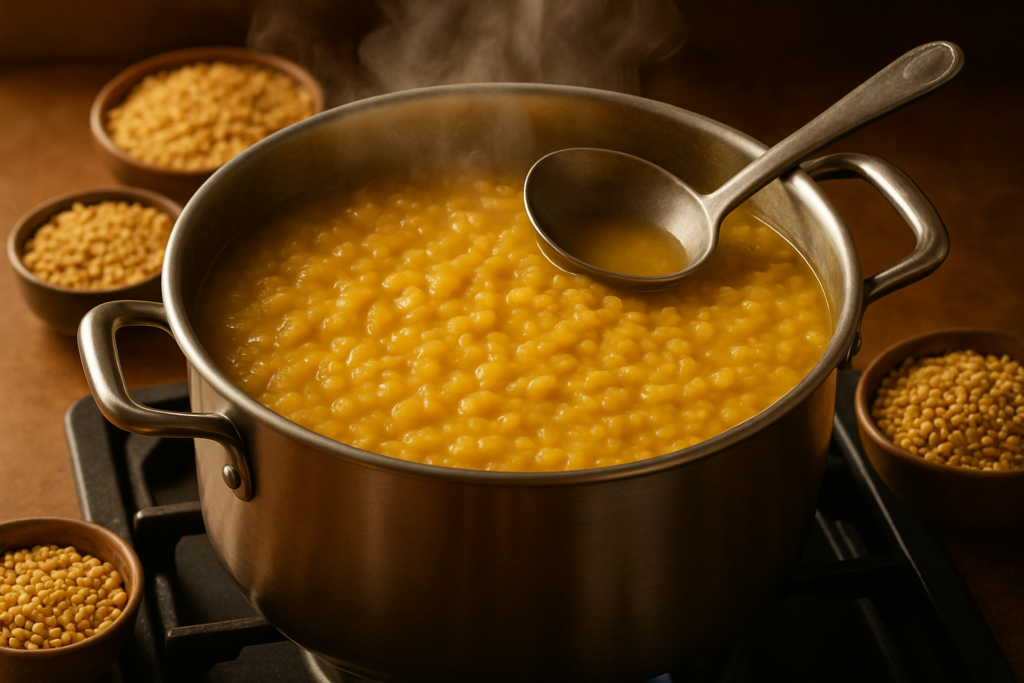
For 20 people at an Indian dinner, use 1.2 to 1.5 kg (about 6–7 cups) of dry dal. This yields roughly 4–4.5 litres of cooked dal. Use the lower end when serving multiple curries and the higher end when dal is the primary protein dish.
The short version
- 60–75 g dry dal per person is the standard range for an Indian meal where dal is one of two or three dishes.
- For 20 people: 1.2 kg at the low end, 1.5 kg at the high end.
- Dal doubles to roughly triples in volume after soaking and cooking, so 1.5 kg dry yields approximately 4–4.5 litres cooked.
- If dal is the only main dish (no paneer, no sabzi), scale up to 90 g per person — about 1.8 kg for 20.
- Toor, masoor, and moong cook down to similar yields; chana dal yields slightly less liquid per kg because it stays firmer.
Why getting this right matters
Dal behaves differently from a dry sabzi: it is ladled over rice or scooped with roti, so guests take a liquid portion rather than a solid piece. This means a single person can consume a surprisingly large volume — 200 to 250 ml of cooked dal per serving is realistic when dal is prominent on the plate. At 20 guests, that is 4 to 5 litres minimum, before accounting for second helpings.
The ratio of dry to cooked dal depends on the variety and how much water you add for consistency:
- Toor dal (arhar): 1 cup dry → roughly 2.5 cups cooked at a pourable consistency.
- Masoor dal (red lentils): 1 cup dry → roughly 2.5–3 cups cooked; it breaks down more completely and absorbs more water.
- Moong dal (split yellow): Similar to masoor. Cooks faster and yields a slightly thicker, denser result per cup.
- Chana dal: Holds its shape; you get less liquid volume per cup but a heartier texture. Increase quantity by about 10% if substituting for toor.
The critical variable is the menu context. At a typical Indian dinner with dal, one vegetable dish, raita, and rice or roti, guests moderate their dal intake. At a simpler meal — dal, rice, pickle — consumption rises sharply because dal is filling the protein and flavour role alone.
How to calculate for your specific dinner
- Identify dal’s role. Count the number of substantial dishes (curries, paneer, a second dal, a dry sabzi). More dishes means lower per-person dal consumption.
- 3+ substantial dishes: use 60 g per person → 1.2 kg for 20.
- 1–2 substantial dishes: use 75 g per person → 1.5 kg for 20.
- Dal as the only main: use 90 g per person → 1.8 kg for 20.
- Account for guest profile. A dinner that includes children or light eaters can trim 10%. A dinner of adults who eat heartily, or where roti is the only carb (roti eaters consume more dal than rice eaters because dal acts as the moisture for each bite), add 10–15%.
- Check your pressure cooker or pot capacity. 1.5 kg dry toor dal, once soaked, expands significantly. You will need a vessel that holds at least 6–7 litres to cook it comfortably and to add the tadka without overflow.
- Soak when the variety requires it. Toor and chana dal benefit from a 30–60 minute soak, which shortens pressure cooking time and improves texture. Masoor and moong cook fast without soaking. Soaking does not change final yield significantly but makes cooking more predictable at large volumes.
- Season and tadka at full volume. Salt, turmeric, and the tadka (mustard seeds, dried chilli, hing, curry leaves) need to be proportionally scaled. A common undercooking error at large batch sizes is under-salting because cooks taste a small spoonful rather than accounting for the full pot. Taste the dal after the tadka is stirred in and the pot has rested two minutes.
Quick reference table
| Guests | Dal as one of 3+ dishes | Dal as main dish |
|---|---|---|
| 10 | 600 g | 900 g |
| 20 | 1.2 kg | 1.8 kg |
| 25 | 1.5 kg | 2.25 kg |
| 50 | 3 kg | 4.5 kg |
If it still does not work
Dal too thick after cooking: Add hot water in 250 ml increments, stir, and bring back to a single boil. Never add cold water to a fully cooked pot — it dull the flavour and can cause uneven texture in lentils that have already broken down.
Dal too thin: Simmer uncovered for 5–10 minutes. Masoor and moong will thicken quickly; toor takes longer. Alternatively, remove one cup of dal, mash it to a paste, and stir it back in. This thickens without altering flavour.
Undercooked lentils in a large batch: The most common cause is insufficient pressure cooking time when the quantity is scaled up. A domestic pressure cooker reaching full pressure with 1.5 kg soaked toor dal may need 3–4 whistles rather than the 2 whistles you use for a small home batch. Check a few lentils — they should crush between two fingers with no resistance at all.
Bland or flat-tasting dal at scale: Large volumes dilute the tadka. For 1.5 kg dry dal, use a tadka made in at least 4–5 tablespoons of ghee or oil, with proportionally scaled aromatics. A single small tadka poured into a 5-litre pot disappears.
Related questions
How much rice should I cook alongside the dal for 20 people?
Plan 75–100 g dry rice per person, so 1.5–2 kg for 20 guests. If roti is also being served, use the lower end. Long-grain basmati absorbs about 1.5 to 2 times its weight in water and roughly doubles in volume when cooked.
Can I cook the dal a day ahead for a large gathering?
Yes, and it often tastes better the next day as flavours deepen. Cook the dal fully, cool it uncovered, then refrigerate in sealed containers. Reheat gently with a splash of water, then add a fresh small tadka just before serving — the reheated tadka restores the aroma that fades during storage.
What is the best dal variety for cooking in bulk?
Toor dal (arhar) is the most forgiving at large volumes — it holds consistency well, reheats evenly, and suits a wide range of regional tadka styles. Masoor dal is faster to cook and needs no soaking, making it practical when time is short. Chana dal stays firmer, which is useful if you want distinct texture rather than a smooth consistency.
How much toor dal for 25 guests specifically?
At 60–75 g per person with other dishes on the menu, 1.5–1.9 kg of dry toor dal covers 25 guests. Round up to 2 kg if the guest count could be slightly higher than expected or if second helpings are likely.
Does soaking dal before cooking affect how much I need to buy?
No. Soaking reduces cooking time and improves texture but does not change the dry weight you need to purchase. Buy based on the dry gram quantities in the table above, then soak as required by the variety.
One thought on “Dal Quantity for 20 People: How Much to Cook”