Janmashtami Recipes: 20 Traditional Bhog and Prasad Dishes for Krishna Jayanti
20 Traditional Janmashtami Bhog and Prasad Recipes for Krishna Jayanti
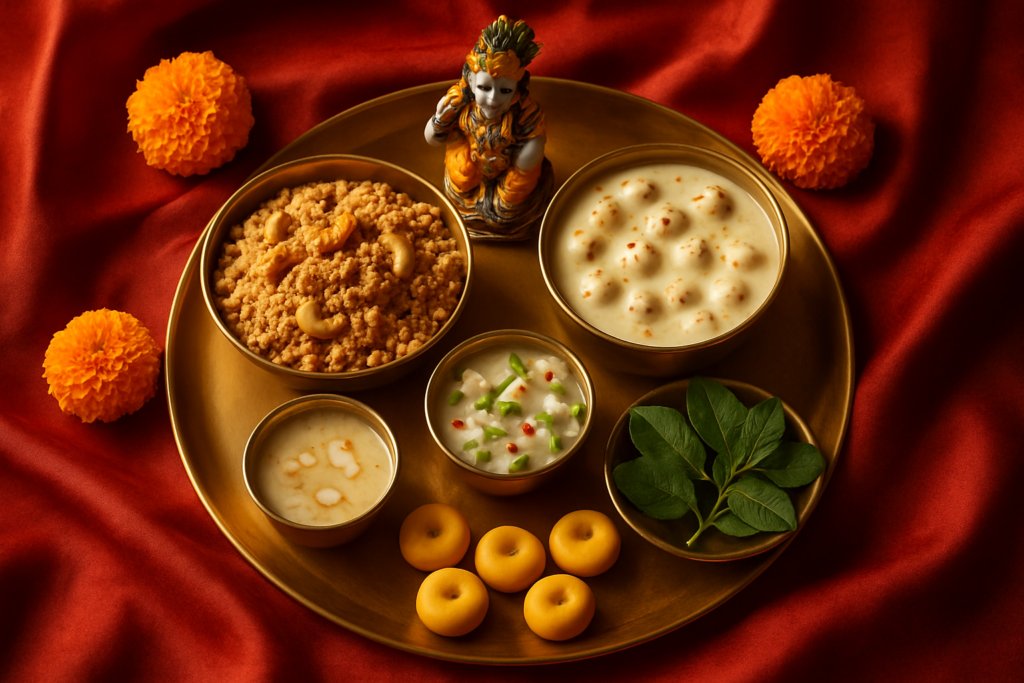
Janmashtami — also called Krishna Jayanti — celebrates the birth of Lord Krishna, and the food made on this day is unlike anything else in the Indian festival calendar. Every dish goes into a bhog thali placed before Bal Gopal at midnight, and the entire household fasts until then. These janmashtami recipes cover 20 traditional dishes — from the simplest panchamrit to the labour-of-love Gopalkala — with every technique explained so the results are consistent and authentic.
It’s not just cooking. It’s an offering. The anticipation makes everything taste better.
Prep Time: 45 minutes | Cook Time: 60 minutes | Total Time: ~2 hours (plus soaking time for sabudana) | Servings: 8-10 people
This collection of janmashtami recipes covers the 5 most essential bhog dishes — Panjiri, Makhana Kheer, Panchamrit, Gopalkala, and Sabudana Kheer — plus guidance on 15 more traditional prasad items. All recipes are satvik (no onion, no garlic), suitable for fasting, and beginner-friendly.
Why You’ll Love These Janmashtami Recipes
- Completely satvik and pure: Every single recipe is no-onion, no-garlic, made with clean, simple ingredients that are considered auspicious for offering to the deity.
- Beginner-friendly: Each step includes sensory cues — panjiri is done by smell, not just a timer.
- Make-ahead friendly: Most of the prasad recipes can be prepped the night before or morning of the festival, so you’re not scrambling at midnight.
- Diaspora-friendly substitutions: If you’re celebrating Janmashtami in London, Toronto, or Melbourne, swaps for hard-to-find ingredients are included throughout.
- Rooted in tradition: These aren’t trendy fusion dishes. These are the recipes that have been made in Mathura, Vrindavan, and Dwarka households for generations.
The 20 Traditional Janmashtami Recipes at a Glance
Before we dive into the detailed recipes, here’s your complete festival menu, divided into essential bhog items, sweet prasad dishes, and savoury vrat-friendly items.
Essential Bhog Items (Non-Negotiable in Most Homes)
- Panchamrit — the sacred five-ingredient mixture (curd, honey, ghee, milk, gangajal)
- Panjiri — roasted wheat flour with dry fruits and gond
- Gopalkala — soaked poha with fresh coconut (Krishna’s preferred snack, according to legend)
- Tulsi and fresh flowers — not food, but placed on every bhog thali
- Chappan Bhog — if you’re ambitious, the traditional offering of 56 items (we’ll discuss a simplified version below)
Sweet Janmashtami Prasad Recipes
- Makhana Kheer — fox nut pudding in thickened milk
- Sabudana Kheer — sago pearl pudding, creamy and delicate
- Singhara Halwa — water chestnut flour halwa, nutty and rich
- Peda — milk-based fudge, Krishna’s absolute favourite according to every temple tradition
- Mawa Ladoo — khoya-based laddoos rolled in coconut
- Mishri and Dry Fruit Ladoo — quick no-cook prasad
- Charnamrit — thinner version of panchamrit used for abhishek
- Kheer — simple rice kheer with saffron (after the fast is broken)
- Banana and Fruit Bhog — fresh seasonal fruits, always included
- Butter and Mishri — Makhan Mishri, the simplest and most beloved offering to Bal Gopal
Savoury Vrat-Friendly Janmashtami Bhog Recipes
- Aloo Jeera — simple cumin potatoes, sendha namak only
- Kuttu Ki Puri — buckwheat flour pooris, crispy and filling
- Sabudana Vada — fried sago pearls and potato patties
- Lauki Ka Raita — bottle gourd in curd with sendha namak
- Murmura Laddoo — puffed rice balls bound with jaggery
Ingredients You’ll Need for These Janmashtami Recipes
The key ingredients for the 5 core recipes are listed here. The full ingredient list for all 20 dishes is detailed in their individual sections below.
For Panjiri
- Whole wheat flour (atta) — use regular chakki atta, not maida
- Ghee — please don’t substitute with oil here. The flavour of panjiri is 80% the ghee. Homemade ghee or Amul works well.
- Boora (powdered raw sugar) or mishri powder — adds a slightly different sweetness than regular powdered sugar. Abroad: use powdered raw cane sugar or light brown icing sugar.
- Gond (edible gum) — Abroad: find it at Indian grocery stores labelled as ‘gond’ or ‘edible gum crystals’. Can be skipped without ruining the recipe.
- Mixed dry fruits: almonds, cashews, raisins — and melon seeds (magaz) if you can find them
For Makhana Kheer
- Makhana (fox nuts / lotus seeds) — available at all Indian stores and increasingly at Whole Foods or Holland & Barrett. No substitute — they’re the star of the dish.
- Full-fat whole milk — don’t use low-fat or the kheer won’t thicken properly
- Sugar, cardamom, saffron — pantry staples
For Panchamrit
- Fresh curd (yogurt) — homemade is ideal; use full-fat Greek yogurt if abroad
- Raw honey — use the good stuff here, it’s for the Lord
- Pure desi ghee — clarified butter
- Fresh tulsi leaves — Abroad: tulsi is increasingly sold at Indian grocers and even garden centres. Growing it at home is a good option.
For Gopalkala
- Thin poha (flattened rice) — thin variety, not thick
- Fresh coconut, grated — Abroad: frozen grated coconut works perfectly
- Green chillies, cumin seeds, sendha namak (rock salt)
For Sabudana Kheer
- Sabudana (sago pearls / tapioca pearls) — the small-sized variety is best for kheer. Abroad: sold as ‘tapioca pearls’ in Asian grocery stores — same thing.
- Full-fat milk, sugar, cardamom, pistachios
Janmashtami Recipes Step-by-Step — The Core 5
Recipe 1: Panjiri — The Heart of Janmashtami Prasad
Panjiri is warming, nutty, sweet, and genuinely one of the most comforting things you can eat as prasad.
- Heat 1 cup ghee in a heavy-bottomed kadai over medium-low flame. The kadai should be wide and have high sides — atta roasting can splutter.
- Add gond crystals in small batches — about 1 tablespoon at a time. They’ll puff up dramatically into crispy golden spheres within 20-30 seconds. Remove quickly and drain on a plate. Repeat with remaining gond. Be careful — they go from perfectly done to burnt in seconds.
- In the same ghee (add a little more if needed), add 2 cups whole wheat flour. Reduce flame to low. Stir continuously for 20-25 minutes. This is the step that makes or breaks panjiri. Look for a deep golden colour — like tanned skin — and a smell that is almost biscuity and nutty. Rushing this on high heat gives patches of burnt flour and raw flour in the same batch. Low and slow is essential.
- Add chopped almonds, cashews, raisins, and melon seeds. Roast together for another 3-4 minutes until the cashews turn golden. Turn off the flame.
- Let the mixture cool for exactly 10 minutes — not fully cold, but not hot either. Then add powdered sugar (1 cup), crushed fried gond, and 1 tsp cardamom powder. Mix thoroughly. Adding sugar to hot atta makes it clump and melt.
- Taste and adjust sweetness. Transfer to a clean container. Panjiri firms up as it cools.
Recipe 2: Makhana Kheer — Creamy Fasting-Friendly Bliss
Makhana (Euryale ferox), also called fox nuts or lotus seeds, has been eaten in India for thousands of years and is one of the most auspicious foods offered to Krishna. A good makhana kheer is one of the most underrated Indian desserts — not just a festival food.
- Heat 1 tsp ghee in a wide non-stick pan. Add 2 cups makhana and roast on low-medium flame, tossing constantly, for 8-10 minutes. They should become light, crispy, and very pale golden. Bite into one — it should be crunchy all the way through with no soft centre. If it’s still soft, keep roasting.
- Let the makhana cool slightly, then roughly crush about half of them in your palms or in a mortar. Keep the other half whole — the contrast of textures is what makes this kheer interesting.
- Pour 1 litre full-fat milk into a heavy-bottomed pot. Bring to a full boil over medium heat, stirring occasionally so the bottom doesn’t catch. Once boiling, reduce to the lowest flame.
- Add the makhana (both crushed and whole) to the simmering milk. Stir to combine. Simmer on low for 20-25 minutes, stirring every 3-4 minutes. The crushed makhana will dissolve into the milk and thicken it beautifully; the whole ones give you something to chew.
- Add 4 tbsp sugar and 1 tsp cardamom powder. Stir well and simmer another 5 minutes. Add saffron strands soaked in 2 tbsp warm milk if using.
- Serve warm in small clay cups (matkas) or silver katoris. Garnish with a sliver of almond. Can be refrigerated and served cold the next day — it tastes even better cold.
Recipe 3: Panchamrit — The Sacred Five-Ingredient Mixture
Panchamrit isn’t really a “recipe” in the cooking sense — it’s a ritual preparation. The five ingredients represent the five elements and are considered purifying and auspicious. Some families use it purely for abhishek (bathing the deity idol) and make a fresh batch to distribute as prasad. Others offer the same mixture. Both are completely valid.
- Use a clean silver, brass, or clay bowl — avoid aluminium or steel if possible, though this is more traditional preference than rule.
- Add in this order: 2 tbsp fresh curd, 2 tbsp honey, 1 tbsp pure ghee, 2 tbsp fresh milk, and 1 tbsp gangajal or clean water.
- Stir gently with a spoon — don’t whisk aggressively. The mixture will look slightly curdled, which is normal.
- Add 2-3 fresh, washed tulsi leaves. Tulsi is absolutely essential — it’s considered non-vegetarian without tulsi, in the spiritual sense.
- Offer to the deity during puja, then spoon into small portions for everyone present. A teaspoon per person is traditional.
Recipe 4: Gopalkala — Krishna’s Midnight Snack
According to stories passed down in Mathura, young Krishna and his cowherd friends (the Gopas) would eat soaked poha mixed with curd, coconut, and whatever was at hand after returning from grazing the cows. This is why Gopalkala is offered at midnight when his birth is celebrated — it’s literally his favourite food according to tradition.
- Take 1 cup thin poha and rinse in a colander under running water for 30 seconds. Let it sit and soften for 5 minutes — you want it soft but not mushy. Each flake should be separate.
- In a large bowl, combine the drained poha with 1/2 cup grated fresh coconut, 2 finely chopped green chillies, 1 tsp cumin seeds, sendha namak to taste, a squeeze of lemon, and chopped fresh coriander.
- Mix gently with clean hands or a fork. Do not overmix or the poha will turn to mush.
- Some families also add a few teaspoons of thick curd and chopped cucumber. Both are lovely additions.
- Offer fresh immediately — this does not store well and should never be made ahead.
Recipe 5: Sabudana Kheer — Fasting-Friendly and Utterly Delicious
- Soak 1 cup sabudana in just enough water to cover, for 2-3 hours. After soaking, each pearl should have plumped up significantly. Drain any excess water completely.
- Bring 1 litre full-fat milk to a boil, then reduce to a simmer.
- Add the drained sabudana pearls and stir immediately to prevent clumping. Cook on low flame for 15-20 minutes, stirring every few minutes. The pearls will turn from opaque white to translucent — that’s when you know they’re cooked through.
- Add 1/2 cup sugar and 1 tsp cardamom powder. Stir and cook another 5 minutes. The kheer will thicken as it cools, so remove from heat when it’s a little thinner than you want the final texture to be.
- Garnish with chopped pistachios. Serve warm for the bhog, or chilled as prasad the next day.
Tips for Perfect Janmashtami Recipes Every Time
- Ghee quality is everything: For prasad, use the best quality ghee available. The best branded desi ghee makes a real difference in flavour.
- Low and slow wins: Both panjiri atta roasting and makhana kheer thickening need patience on low flame. Rushing either with high heat gives uneven results — raw pockets in panjiri, and scorched milk in kheer.
- Always add sendha namak (rock salt) in fasting recipes, not regular salt: This is non-negotiable on vrat days. Keep a separate small container of sendha namak in your kitchen during festival season.
- Prepare bhog in a clean kitchen: Traditionally, bhog is prepared after a bath, in a clean kitchen, without tasting (since the food is for the deity first). Cooking in a calm, intentional state genuinely changes how the food feels.
- Scale up panjiri — it keeps for weeks: Make a large batch of panjiri and store it in an airtight jar. It keeps for 3-4 weeks at room temperature and makes a beautiful edible gift for anyone who visits during the festival.
Variations for Different Dietary Needs
Jain Janmashtami Recipes (No Root Vegetables)
All 5 core recipes above are already Jain-friendly — no root vegetables, no underground produce. For the savoury options from the list of 20, skip the aloo jeera and sabudana vada (which contain potato) and substitute with lauki (bottle gourd) preparations instead.
No-Onion No-Garlic (Satvik)
Every single janmashtami prasad recipe in this post is strictly no-onion, no-garlic by default. This is the satvik food tradition — these ingredients are considered rajasic (stimulating) and are avoided on auspicious occasions and fasting days.
Vegan Janmashtami Recipes
I know purists will disagree with me here, but if you need vegan options — swap dairy milk for oat milk or cashew milk in the kheer recipes (cashew milk works best for creaminess), use coconut oil in place of ghee for panjiri, and skip the honey in panchamrit, replacing it with date syrup or maple syrup. The spirit of the offering matters more than a rigid ingredient list, in my personal opinion.
Gluten-Free Janmashtami Recipes
Makhana kheer, sabudana kheer, panchamrit, gopalkala, and singhara halwa are all naturally gluten-free. The only recipe that contains gluten in the core 5 is panjiri (whole wheat flour). For a gluten-free panjiri, use kuttu atta (buckwheat flour) or singhara atta (water chestnut flour) — both are used during Navratri fasting and work beautifully.
What to Serve With This Janmashtami Bhog Spread
After midnight, once the fast is broken with the bhog prasad, most families serve a proper meal. Here’s what pairs beautifully:
- Kuttu Ki Puri with Aloo Jeera: The classic Janmashtami fast-breaking meal. Crispy buckwheat pooris with simple cumin potatoes — filling, satisfying, and completely vrat-appropriate. Check out my Kuttu Ki Puri recipe for a foolproof version.
- Lauki Ka Raita: Cool, fresh bottle gourd in thick yogurt with sendha namak and roasted cumin. A perfect contrast to the richness of panjiri and kheer.
- Fruit Platter with Makhan Mishri: A plate of fresh seasonal fruits — banana, grapes, mango if in season — alongside a little bowl of white butter and mishri (rock sugar). This is Krishna’s most beloved simple offering and it’s the perfect fresh finish to a heavy bhog spread.
For a complete Janmashtami menu plan, also see my vrat recipes collection and satvik cooking guide.
Storage and Reheating
Panjiri
Stores beautifully in an airtight glass or steel container at room temperature for up to 3-4 weeks. Do not refrigerate — the condensation ruins the texture. If you live in a very humid climate, store in a cool, dry cupboard.
Makhana Kheer and Sabudana Kheer
Refrigerate in covered containers for up to 2-3 days. The kheer will thicken considerably when cold — add a splash of warm milk and stir gently before serving. Reheat on low flame on the stovetop; avoid microwaving as it can make the makhana rubbery.
Singhara Halwa
Best eaten fresh and warm. Will keep in the refrigerator for 1-2 days. Reheat in a pan with a small spoon of ghee on low flame, stirring until warmed through and glossy again.
Gopalkala
Must be eaten fresh — within 1-2 hours of making. Does not store.
Panchamrit
Always made fresh on the day. Never stored.
A Note on the Significance of What You’re Cooking
These janmashtami recipes are not just a list of dishes. They’re an act of devotion. The reason makhana is considered so special isn’t just its nutritional profile — it’s that it represents purity and auspiciousness in Indian food tradition. The reason ghee and not oil goes into panjiri isn’t just flavour — it’s an act of generosity toward the divine.
Whether you’re deeply devout or cooking these recipes simply to connect with your culture and heritage, the hope is that this Janmashtami your kitchen fills with the warmth of ghee, roasted atta, and cardamom rising through the night while you wait for midnight and Kanha’s arrival. Jai Sri Krishna. 🙏
Frequently Asked Questions About Janmashtami Recipes
Can I make janmashtami recipes without onion and garlic?
Yes — and you absolutely should! All traditional janmashtami bhog recipes are strictly satvik, meaning no onion, no garlic, and no meat. The recipes in this post are all 100% no-onion-no-garlic. Even the savoury gopalkala uses only green chillies and cumin for flavour.
What is the difference between bhog and prasad on Janmashtami?
Bhog is the food you prepare and offer to the deity — it’s the complete meal placed before Krishna’s idol or image. Prasad is what you receive back after the offering — the blessed food that is then distributed to everyone. So technically, everything becomes prasad after it’s been offered. On Janmashtami, the bhog is traditionally offered at midnight, after which the fast is broken.
Can I prepare janmashtami recipes a day in advance?
Panjiri and dry snacks like murmura laddoo can easily be made 2-3 days in advance and stored in airtight containers. Makhana kheer and sabudana kheer can be made the morning of the festival and refrigerated. However, gopalkala (poha mixture) and panchamrit must always be prepared fresh on the day — these don’t hold well.
What can I substitute for gond (edible gum) in panjiri if I can’t find it abroad?
If you’re in the UK, US, Canada, or Australia and can’t find gond at the Indian grocery store, you can simply skip it — panjiri still tastes wonderful without it. Some people substitute with finely chopped dried figs or extra mixed nuts for texture. Gond is mainly added for its warming, energy-boosting properties, so it’s more of a health addition than a flavour one.
Is Janmashtami fasting food the same as the regular bhog recipes?
Not exactly. Fasting (vrat) recipes avoid grains like wheat and rice, and also avoid regular salt — sendha namak (rock salt) is used instead. Dishes like sabudana kheer, makhana preparations, singhara halwa, and fruits are perfect vrat foods. However, gopalkala with regular poha is only eaten after the fast is broken at midnight.